Bedroom Wall Decor Ideas That Make the Whole Room Feel Finished
Seven quiet rules professional stylists hang art by — the 57-inch rule, the two-thirds rule, the frame formula — plus wall-by-wall ideas and renter-friendly fixes. No art degree required.
 By Malik Ashraf · 11 min read
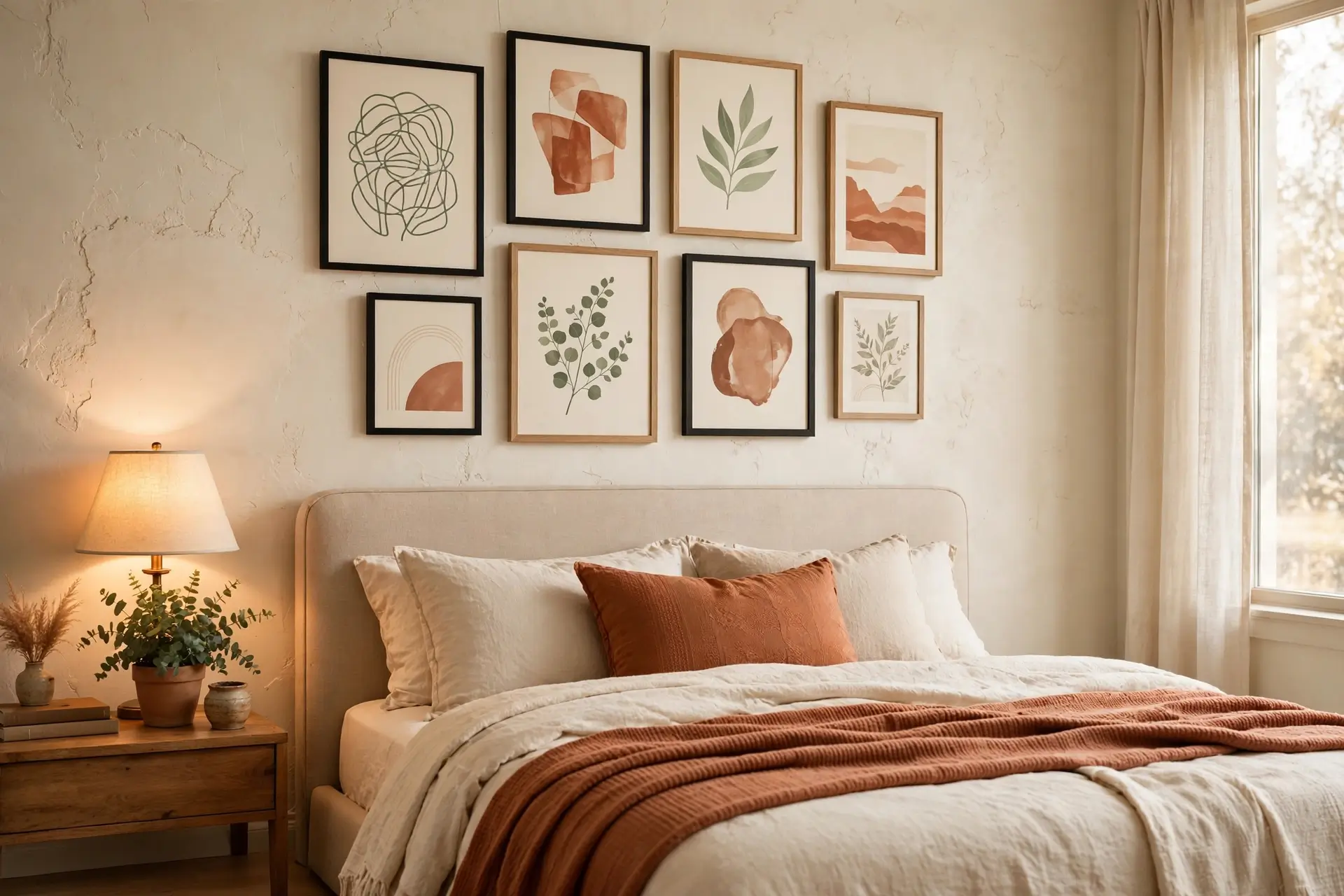
Walk into any bedroom that feels "done" and look at the walls. That's the whole secret. Your walls hold roughly four times the visual area of your floor, yet most bedrooms treat them as an afterthought — one lonely print, hung too high, slightly crooked since 2023.
The frustrating part? It's almost never a taste problem. People with beautiful furniture and lovely bedding still end up with sad walls, because nobody ever hands you the rules. Professional stylists don't have better instincts than you — they just hang art by a handful of quiet, learnable rules about height, scale, and spacing.
This guide hands you seven of those rules. Learn them once and every wall in your home gets easier forever — starting with the bedroom. For the broader collection, browse our wall ideas page.
Hang at Eye Level — The 57-Inch Rule
Galleries worldwide hang art so the center of the piece sits about 57 inches (145 cm) from the floor — average human eye level. It's the single most copied rule in decorating, and the single most ignored one in real homes, where pictures drift upward until they're admiring the ceiling.
The bedroom exception: art hung above furniture follows the furniture, not the floor. Above a headboard or dresser, leave 6 to 8 inches between the furniture top and the frame's bottom edge. Any higher and the art floats away from the bed like a thought bubble; any lower and tall pillows will eat it.
Grab a tape measure and check every frame in your bedroom. If the center is above 60 inches and it's not over furniture, lower it. This one fix costs nothing and changes everything.
Hanging art at "standing eye level" in a bedroom. You experience bedroom walls sitting or lying down — hang for the viewer you'll actually be.
See it: the 57-inch rule
Measure 57 inches up from the floor and mark it lightly with painter's tape. The vertical center of your frame — not the top, not the hook — lands on that line.
For a gallery wall, apply the rule to the center of the whole arrangement, treating the cluster as one big piece. And above the bed? Forget the floor entirely — 6 to 8 inches above the headboard wins.
Size It to the Furniture — The Two-Thirds Rule
Here's why that small print above your king-size bed looks lost: art above furniture should span roughly two-thirds the width of the piece below it. A 60-inch headboard wants art (or an arrangement) about 40 inches wide. A lonely 12-inch frame over a 6-foot bed reads like a postage stamp on a billboard.
This rule is also your permission slip. If one frame can't fill two-thirds of the width, you don't need a bigger budget — you need more pieces. Two medium prints side by side, or a trio, hit the same width as one expensive oversized canvas. Measure the furniture, multiply by 0.66, and shop (or arrange) to that number.
Measure your headboard's width. Cut a paper template to two-thirds of it and tape it to the wall. Live with the outline for a day — your eyes will tell you if the scale feels right before you hang a thing.
Buying art you love in a size that's wrong for the wall, then hanging it anyway. Love it smaller somewhere else; scale is non-negotiable.
Think in Odd Numbers — The Triangle Trick
Stylists group art in threes and fives, and it's not superstition — odd numbers keep the eye moving instead of splitting the wall into neat, boring halves. Two matching prints flanking a bed can look sharp and symmetrical, but three or five pieces arranged loosely feel collected and alive.
The triangle trick makes it foolproof: vary the heights so the tops of your frames trace a rough triangle — one piece higher, two lower, or the reverse. Keep spacing tight and consistent, 2 to 3 inches between frames, and the cluster reads as one intentional composition instead of scattered leftovers. Before a single nail, lay the whole arrangement on the floor and photograph it. The camera catches crooked spacing your eyes forgive.
Gather every small frame you own onto the bedroom floor. Build a triangle of three or five, snap a photo, and adjust until the photo looks balanced. Then trace each frame on kraft paper, tape the papers up, and hang with confidence.
Even spacing across the whole wall like a police lineup. Groupings want to huddle; give them 2–3 inches, not 2–3 feet.
Go Big or Go Home — Scale Is a Feeling
On a large blank wall, one oversized piece beats ten small ones every time. Big art calms a wall down — it gives the eye one place to land, the way a single deep breath beats ten shallow ones. A scatter of small frames across a vast empty wall does the opposite: it emphasizes how empty the wall is. Designers call it visual confetti, and it's the most common reason gallery walls fail.
Oversized doesn't mean overpriced. An engineering print from a copy shop (typically a few dollars for a 3-foot-wide black-and-white print), a thrifted frame, a stretched canvas drop cloth you paint yourself — scale is about size, not spend. If your wall is wider than your outstretched arms, think in feet, not inches.
Tape newspaper sheets together into one big rectangle — say 3 by 4 feet — and stick it on your emptiest wall. If the room suddenly feels calmer and more expensive, you've just proven the rule to yourself.
Starting with small pieces and "building up later." Later never comes, and the wall stays in permanent draft mode.
The Frame Formula — Two Finishes, One Mat
Eclectic art, disciplined frames. The formula stylists actually use: no more than two frame finishes per room — black plus natural wood is the classic pairing that goes with everything. Mismatched art in matching frames looks like a collection; matching art in mismatched frames looks like a yard sale.
The secret weapon is the mat — that white border inside the frame. A wide white mat makes a $5 thrift-store print look gallery-grade, and it unifies wildly different art styles into one family. When in doubt, mat it: white mats, simple frames, and suddenly your random prints look like they were curated together on purpose.
Pull every frame in the bedroom onto the bed. Count the finishes — if you're past two, pick your favorites and demote the rest to other rooms. Then add white mats to whatever remains; pre-cut mats cost a few dollars each.
Ornate gold frame + sleek black frame + rustic barnwood, all on one wall. Each frame is shouting; none of the art gets heard.
Leave the Frames Behind — Walls Want Texture
Frames are the default, not the requirement. Some of the best bedroom walls have no glass at all — because texture reads as warmth in a way flat prints can't. And several of these options are cheaper, lighter, and more renter-friendly than framed art:
Mirrors — an arched or round mirror doubles light and visually doubles the room; textiles — a tapestry, macramé hanging, or quilt adds softness and quietly absorbs sound; picture ledges — a narrow shelf lets you layer and swap art without new holes every season; wall baskets or plates — woven texture that costs little and weighs nothing; plants — a wall-mounted planter or trailing pothos on a high shelf brings the wall alive; light as decor — a plug-in sconce or fairy lights on the wall count as wall decor too, and they do double duty after dark.
Pick your flattest, dullest wall and add one non-frame thing: a leaning mirror, a textile, or a single shelf with two objects. Notice how the room's whole texture changes.
A wall of nothing but small framed prints — flat, flat, flat. Mix at least one dimensional or textile piece into every arrangement.
Leave Breathing Room — Negative Space Is a Choice
The final rule is restraint: not every wall needs something. Negative space — plain, quiet wall — is what makes your decorated walls look decorated. A bedroom with one strong wall and three calm ones feels curated; a bedroom with something on every surface feels noisy. Stylists literally plan which walls stay empty.
The doorway test settles it: stand in your bedroom doorway and take in the whole room. If your eye bounces frantically wall to wall, edit something out. If it lands softly on one focal wall and rests, you're done. Coziness, as we explored in our small bedroom ideas guide, is as much about what you leave out as what you put in.
Take one thing off your busiest wall — just one — and live with the gap for 48 hours. Most people never put it back.
Filling the last empty wall because it's empty. Emptiness is doing a job: making everything else look intentional.
Wall by Wall: Where Each Idea Belongs
Rules learned — now placement. Not all bedroom walls are equal, and each one wants a different treatment:
behind the bed
The star of the room — give it the drama
This is the first wall you see from the doorway and the backdrop of every photo, so it earns your best piece: a symmetrical gallery grid, one oversized canvas (Rule 4), or a painted arch in terracotta or sage that frames the bed like a halo — a favorite from our wall ideas collection. Apply the two-thirds rule strictly here; this wall forgives nothing.
blank wall
Go big, or go textural
The wall opposite the bed is usually the largest and emptiest. One oversized piece, a leaning floor mirror (which also bounces light back at you), or a large textile. This is the worst place for small scattered frames — scale up or stay empty. In a small bedroom, a mirror here is the closest thing to adding square footage.
awkward walls
Above the dresser, beside the window, the sliver by the door
Small walls want small moves: a single print above the dresser (two-thirds of the dresser width, 6–8 inches above it), a tiny gallery of three beside the window, one leaning frame on a nightstand for the sliver walls. These are also the perfect testing ground — try a new arrangement here before committing to the big walls.
Renting? The No-Drill Playbook
Everything above works without a single hole in the wall. Renters have better options than ever — the only real rule is check the weight rating on any adhesive product and follow the removal instructions exactly (warm the strip with a hairdryer first; patience beats paint repair).
Lean, don't hang
Large frames and mirrors leaning on a dresser or the floor look intentionally editorial — and require zero wall contact. Anchor tall leaning pieces so they can't tip.
Washi-tape galleries
Tape posters and prints straight to the wall in a grid with patterned washi tape. Dorm-room classic, grown up — the tape becomes part of the design.
Adhesive strips, rated right
Modern removable strips hold real frames — just match the strip's weight rating to your frame and prep the wall with rubbing alcohol first. Keep a few spare strips for moving day.
Peel-and-stick accent
One wall of peel-and-stick wallpaper or a painted-look arch decal gives you a "feature wall" with zero paint and full reversibility. Start behind the bed for maximum impact.
Textiles on a rod
Hang a tapestry or quilt from a tension rod or two adhesive hooks — fabric is light, covers huge wall area cheaply, and softens sound beautifully.
Picture ledges with adhesive
Lightweight ledges mounted with heavy-duty strips create a swappable art shelf. Rotate prints seasonally without ever touching the wall again.
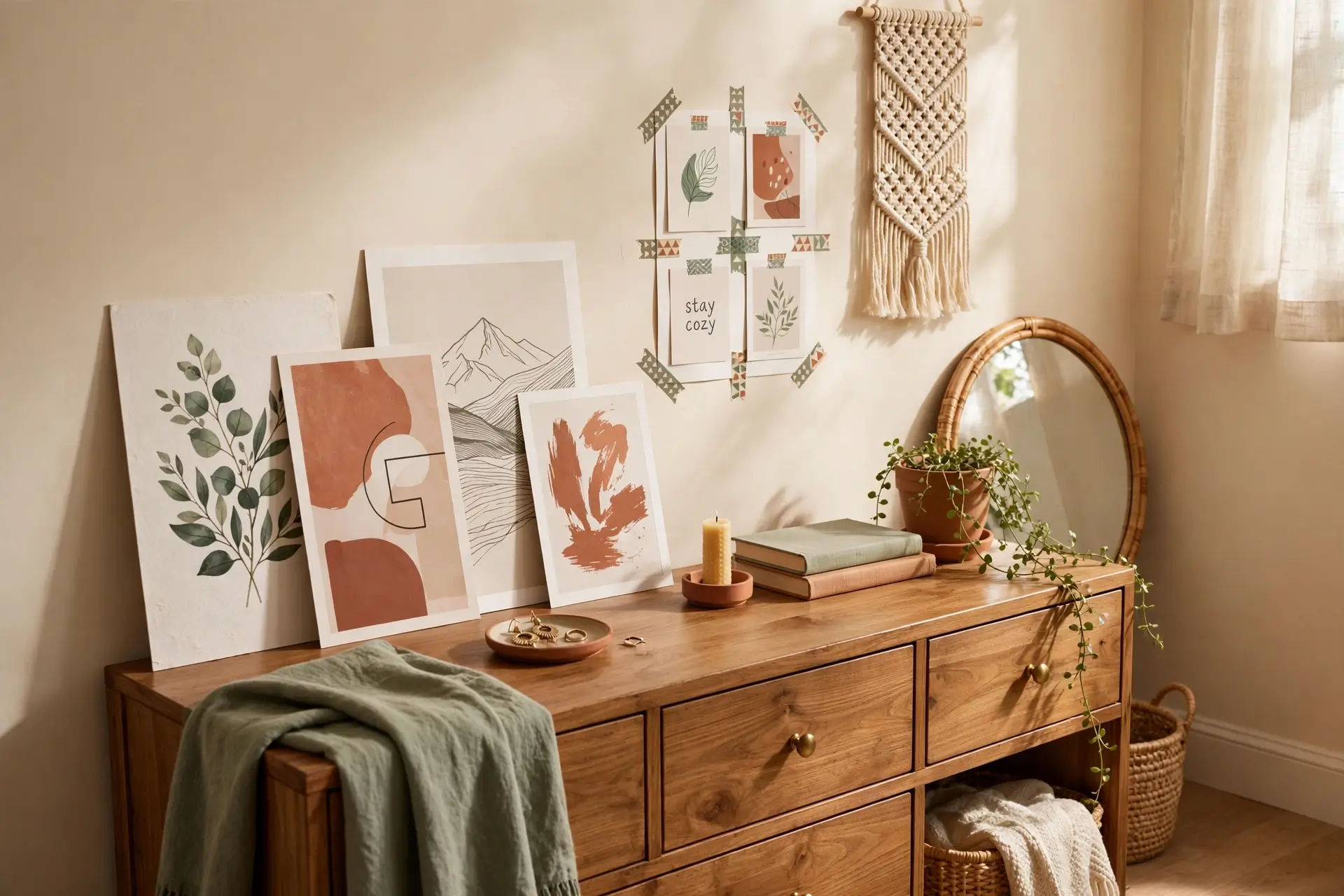
Zero holes, full personality: leaning frames, a washi-tape grid, and one textile — the renter's wall-decor trio.
The One-Wall Weekend Challenge
Don't decorate the bedroom. Decorate one wall — the one behind the bed — this weekend. A single finished wall typically costs $40–150 (thrifted frames plus prints, or one oversized engineering print) and delivers 80% of the transformation.
- Saturday morning — measure & plan (30 min). Measure the headboard width, multiply by 0.66 for your target art width. Lay frames on the floor in a triangle (Rule 3), photograph, adjust.
- Saturday afternoon — hang (1 hour). Mark 6–8 inches above the headboard. Hang the center piece first, then build outward keeping 2–3 inch gaps. Step back to the doorway after every piece.
- Sunday — style & step back (20 min). Add one non-frame element if the wall feels flat — a small textile, a trailing plant on the nightstand. Run the doorway test. Done is better than perfect.
Bedroom Wall Decor FAQs
How can I decorate my bedroom walls with no money?
Start free: lower every frame to proper height (Rule 1), rearrange what you own into tighter groupings, and remove one thing from your busiest wall. Print art at a library or copy shop — large black-and-white engineering prints typically cost a few dollars. Frame pages from old books, calendars, or fabric scraps you already own. A washi-tape grid of prints you like costs almost nothing and looks deliberate.
What should I hang above my bed?
Anything you love at the right scale — a gallery grid, one oversized canvas, a mirror, or a textile. Keep it 6–8 inches above the headboard and about two-thirds the bed's width. One safety note: make sure whatever hangs above a bed is secured properly with appropriate anchors or rated adhesive — nothing heavy should rely on a single nail, and in earthquake-prone areas, lighter pieces are the wiser choice.
How high should pictures hang in a bedroom?
Center the piece (or the whole arrangement) about 57 inches from the floor — the gallery standard. Above furniture like a headboard or dresser, ignore the floor: leave 6–8 inches between the furniture top and the frame's bottom. And hang for the viewer you'll be — in a bedroom that's usually someone sitting or lying down, so slightly lower beats slightly higher.
How can I decorate bedroom walls without drilling?
Lean large frames and mirrors instead of hanging them, build washi-tape poster grids, use weight-rated removable adhesive strips (prepping the wall with rubbing alcohol first), hang textiles from tension rods, or apply peel-and-stick wallpaper for a full accent wall. All six methods are covered in the no-drill playbook above — and every one of them moves with you.
Are gallery walls still in style?
Yes — but the style has matured. The anything-goes salon wall of a decade ago has given way to curated clusters: a cohesive color palette, consistent frame finishes (two max), tight 2–3 inch spacing, and breathing room around the arrangement. A tight, intentional grouping of five beats a sprawling wall of twenty random frames every time.
How do I choose wall art colors for my bedroom?
Steal from the room: pull two or three colors already in your bedding, rug, or curtains and choose art that echoes them. You don't need to match exactly — echoing is enough to make the wall feel connected to the room. If your bedroom is mostly neutrals, art is the perfect place for your one bold color; if the room is already colorful, let the art stay quiet.
Where to go next: pair these rules with our bedroom ideas collection for the full room picture, or dive deeper into feature walls on the wall ideas page. Working with a tiny room? Our small bedroom ideas guide shows how to keep snug walls from feeling cramped.
New here? Start at the Roomiora homepage — every idea is real-life tested, honestly costed, and renter-friendly where it matters.
Malik Ashraf
Founder & Editor, Roomiora. Home-design enthusiast sharing real-life room ideas — tested layouts, honest costs, no showroom fantasies.
More about Malik →