Living Room Ideas Without a Coffee Table: Yes, It Actually Works
The coffee table is optional — always was. Four alternatives below — ottoman, side tables, floor lounge, open floor — each of which works better for real life than the rectangle ever did.
 By Malik Ashraf · 12 min read
 🚫 4 NO-TABLE IDEAS
Nobody ever signed a contract saying the living room must contain a coffee table. No building code requires it, no design law mandates it — it's pure habit, inherited from furniture showrooms that needed to fill floor space. Yet most of us arrange the entire room around one — a big wooden rectangle that collects dust, stubs toes at midnight, and blocks the walkway between the sofa and literally everywhere else. Here's the liberating truth: skipping the coffee table doesn't leave a hole in your living room. It leaves room — for kids to play, for traffic to flow, for the space to breathe, for yoga mats and board games and dance parties. Four alternatives below, each with a reference photo and setup instructions. One of them will fit your life better than the table ever did — and you'll wonder why you waited so long.
The mindset shift: a coffee table is a surface, not a requirement. What you actually need is three things: somewhere to put a drink within reach, somewhere to rest your feet, and something that anchors the seating arrangement so the room reads as designed, not accidental. All four alternatives below deliver those three — without the shin-bruising rectangle in the middle. Pick the one that matches your household, or mix two: ottoman plus side tables is a combination that covers every scenario. For more living room thinking, see our living room ideas collection.
Why Skip the Coffee Table?
Three excellent reasons. Kids and toddlers: a coffee table is a corner at head height — removing it baby-proofs the room's most dangerous square meter. Small rooms: the table eats the visual center; without it, the same room feels dramatically larger. Flow: open centers let people (and pets, and robot vacuums) move freely. The coffee table made sense when living rooms were for looking at; modern living rooms are for living in — and living needs floor space. Ask yourself what your coffee table actually does all day. If the honest answer is "holds remotes and collects dust," it's not earning its square meters.
The Ottoman Swap
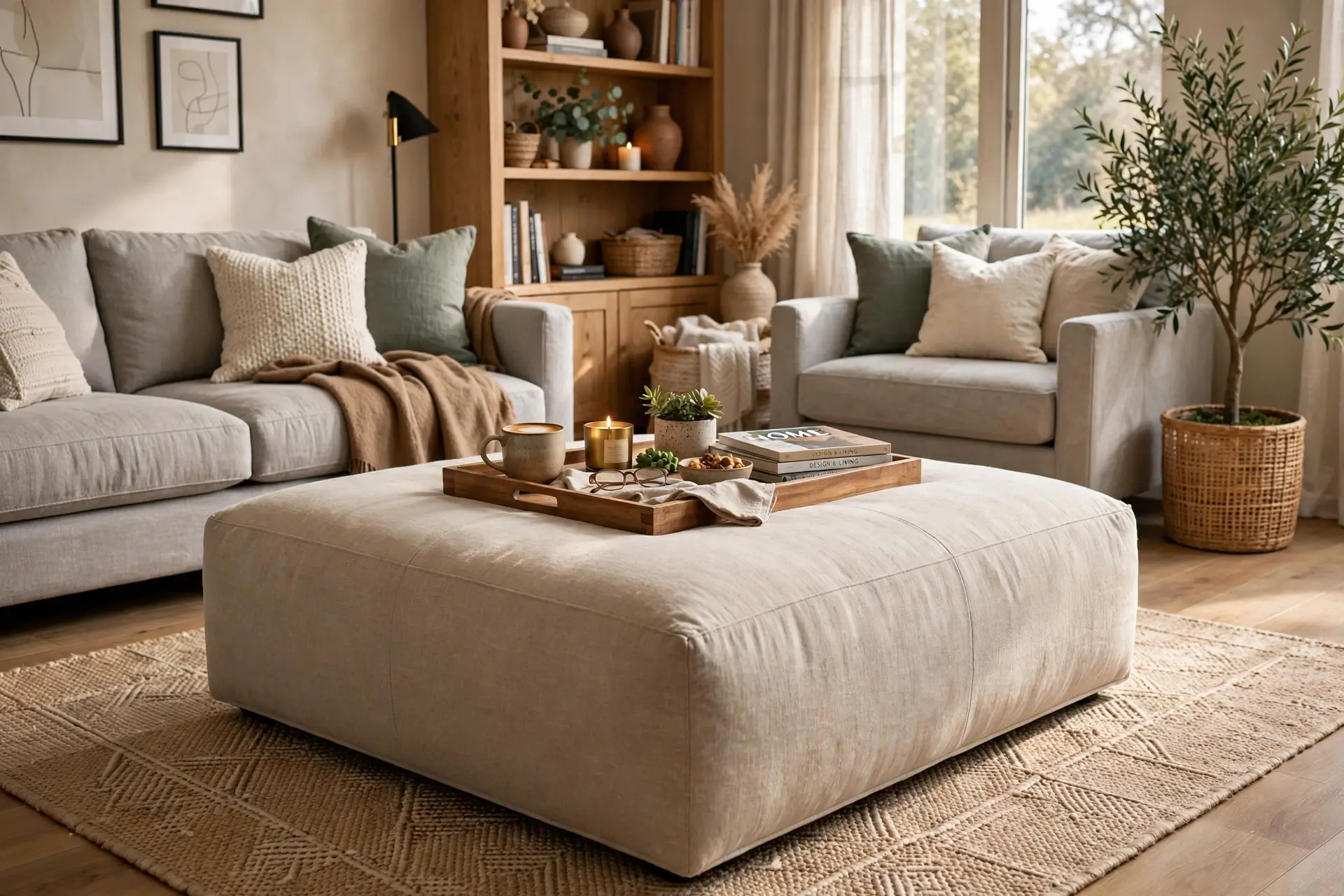
The closest thing to a coffee table without being one: a large ottoman or pouf in the center. It anchors the seating like a table, gives everyone a footrest (the coffee table's most-used feature, honestly), and with a tray on top it holds drinks and remotes just as well. Bonus: no sharp corners, extra seating when guests come, and hidden storage if you choose a storage ottoman. It's the coffee table, but softer, safer, and more useful. If you only take one idea from this article, take this one — the ottoman swap satisfies coffee-table traditionalists and no-table converts alike.
🔄 How to swap it
- Size it right — about two-thirds the sofa's length, same height as the seat cushions.
- Tray on top — a large tray creates the stable surface for drinks and decor.
- Storage inside — choose a storage ottoman and gain the hiding spot every living room needs.
The Side Table Strategy
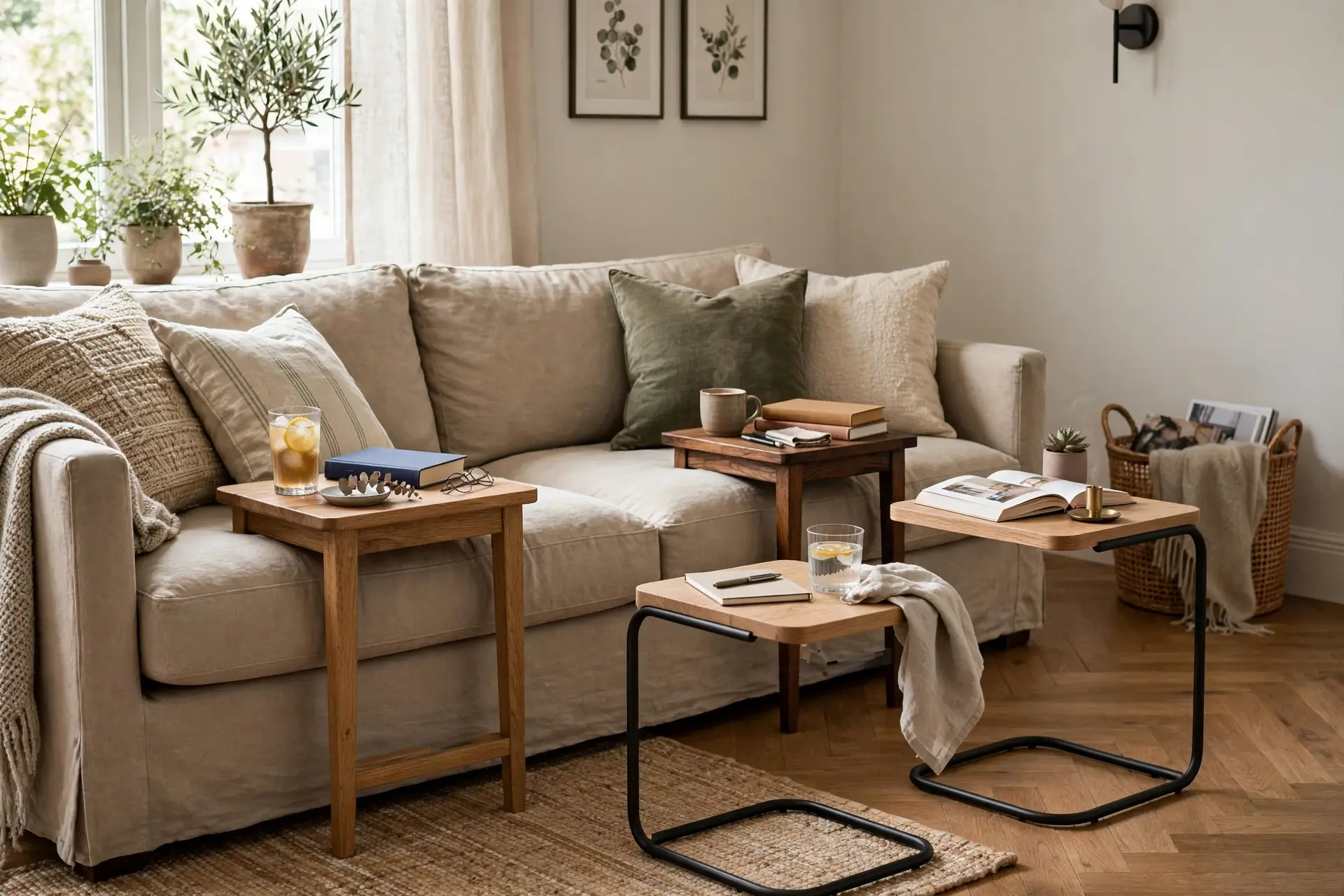
Instead of one big central surface, distribute small surfaces: a side table at each sofa end, C-tables that slide over chair arms, a small stool that moves where needed. Everyone gets a drink within reach — actually closer than a coffee table ever put it — and the center stays gloriously open. This is the most practical alternative for entertainers: surfaces multiply with guests instead of staying fixed in the middle. Pull up a stool, slide over a C-table — the room adapts instead of dictating. Fixed furniture serves the room's layout; distributed furniture serves the people in it.
🔄 How to swap it
- One per seat — every seating spot gets a surface within arm's reach. That's the rule.
- C-tables are magic — they slide over sofa arms and chair seats, putting drinks exactly where hands are.
- Vary heights slightly — visual interest comes from the mix, not matching sets.
The Floor Lounge
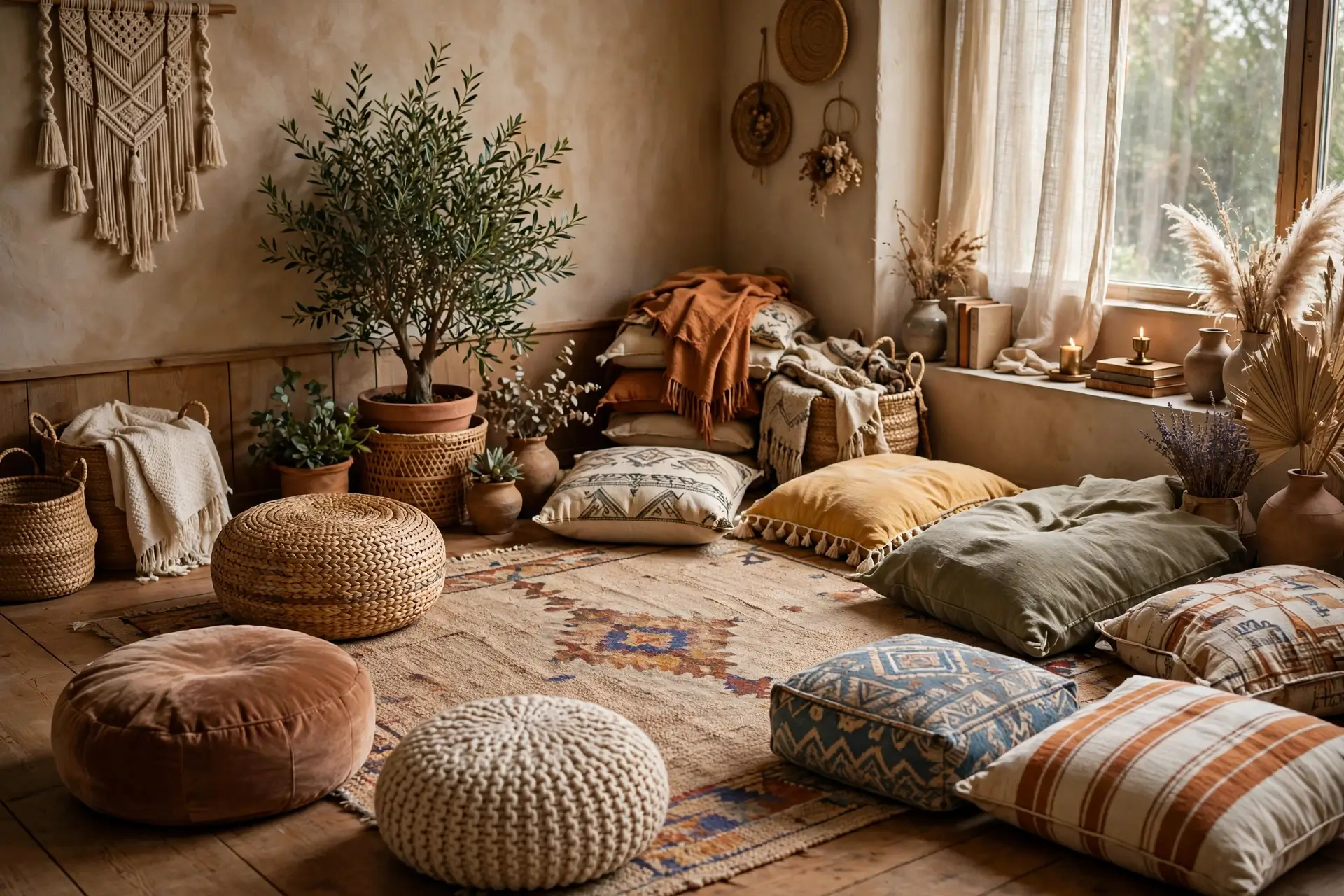
Go low and loose: poufs, floor cushions, and a gorgeous rug replace the entire table concept. This is the bohemian, kid-approved, nap-friendly alternative — seating that moves, stacks, and doubles as play space. A low round tray or Moroccan-style table can float in the middle for drinks without committing to table height. The floor lounge says the living room is for sprawling, not perching — and honestly, isn't sprawling the point? This is also the most kid-and-pet-proof option on this list: nothing to knock over, nothing with corners, everything washable or replaceable.
🔄 How to swap it
- Invest in the rug — it becomes the room's foundation. Big, soft, beautiful.
- Poufs in odd numbers — three or five, varied textures. They stack when not needed.
- One low tray table — optional floating surface for drinks, easily moved aside.
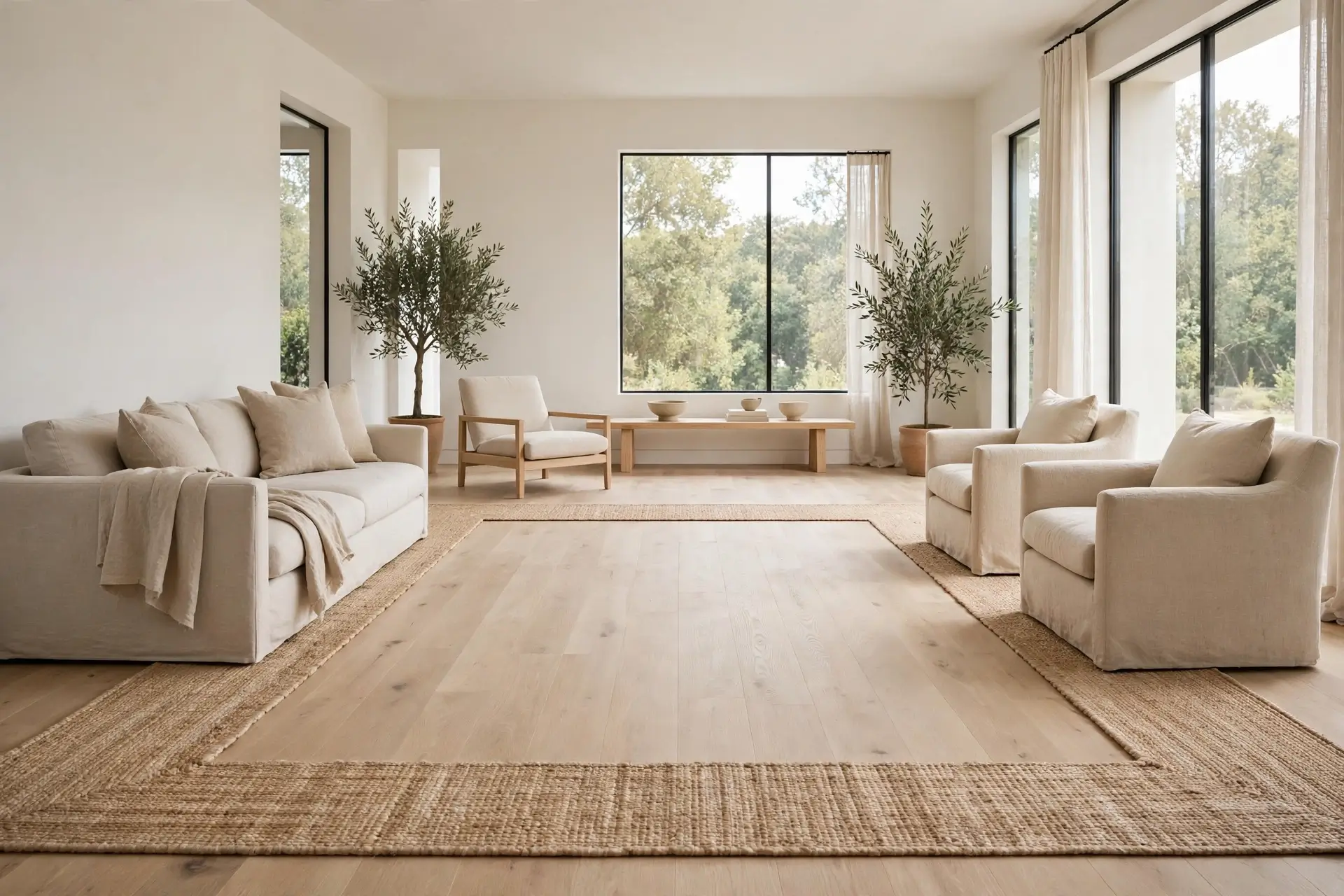
The Open Floor
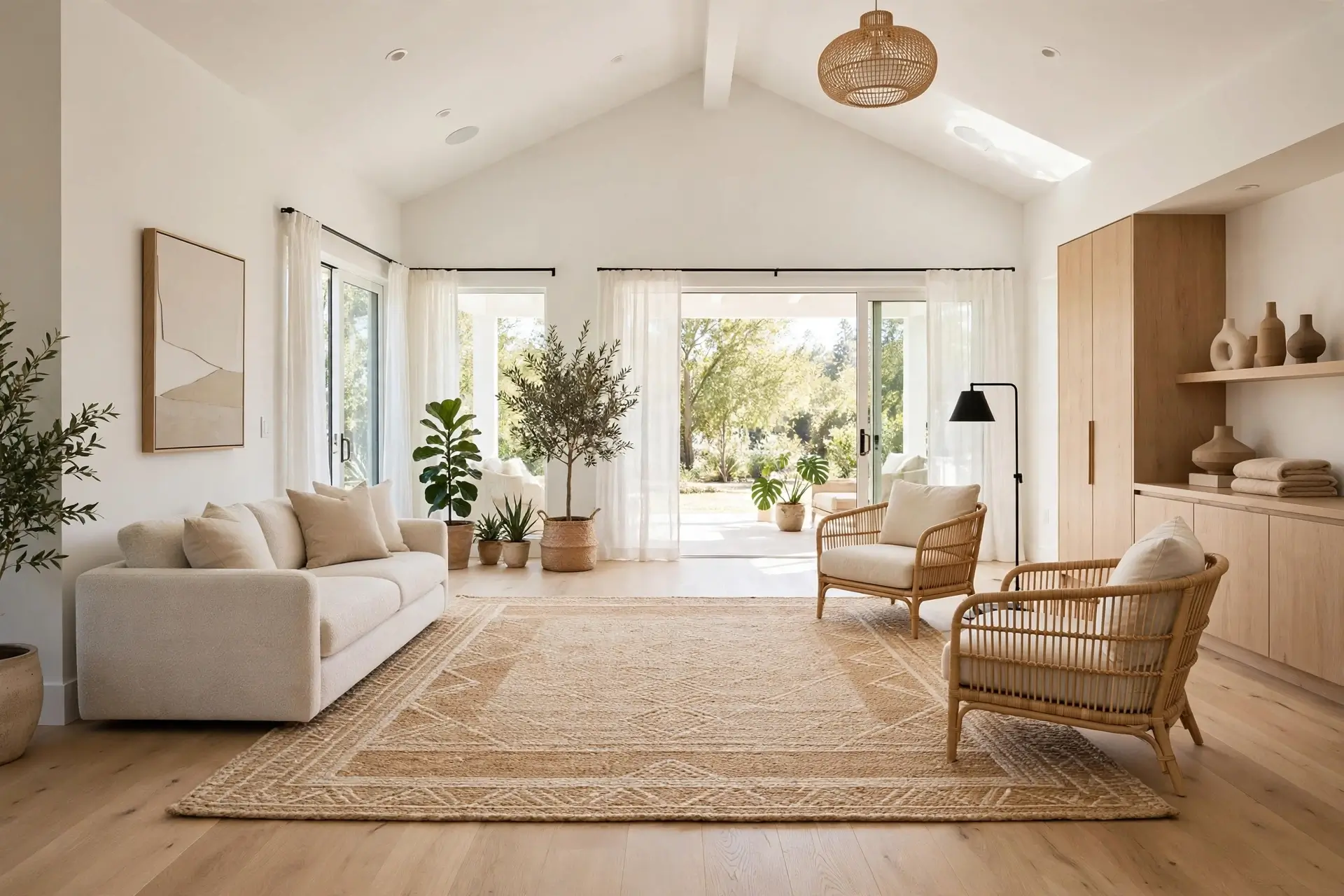
The boldest alternative: nothing in the center at all. A beautiful rug defines the zone, seating rings the edges, and the middle stays gloriously, intentionally empty. This is the minimalist power move — and it's spectacular in small rooms, where the empty center reads as luxury square footage. The key is intention: the rug must be gorgeous, the seating arrangement deliberate, the emptiness clearly a choice. Empty by design, not by indecision. And here's the secret: it's the cheapest alternative on this list. The money you didn't spend on a coffee table buys the spectacular rug that makes the whole thing work.
🔄 How to swap it
- The rug is the star — oversized, high-quality, the best you can afford. It carries the whole center.
- Ring the seating — sofa + chairs in a clear U or L. The arrangement must read as complete.
- Anchor the walls — art, shelves, and lighting on the perimeter so the room doesn't feel unfinished.
🧮 The Surface Math
- Drinks: one surface per seat within arm's reach — side tables, C-tables, or tray-on-ottoman.
- Feet: ottoman, pouf, or the rug itself. (Feet on the coffee table was always a compromise.)
- Remotes & bits: a small lidded basket on a side table, or the ottoman's hidden storage.
- Decor: the rug, the walls, and the side tables carry it — the center doesn't need styling if it's intentionally open.
- The test: sit in every seat with a drink. If it lands somewhere stable within reach, the math works.
Renters: The No-Table Advantage
Renters should love the no-table living room more than anyone: every alternative here is 100% portable, with nothing to mount, drill, or explain at move-out. Ottomans, side tables, poufs, and rugs all move with you — no mounting, no damage, no landlord negotiations. The open-floor version is the ultimate renter move: it makes even a boxy rental living room feel intentional and spacious with zero permanent changes and zero landlord drama. When you move, the whole scheme fits in a car — ottoman in the back seat, poufs in the trunk, rug rolled on the roof. Try that with a built-in media wall.
✨ Styling the Empty Center
An open center still needs intention to avoid looking unfinished. The formula: a statement rug (pattern or texture with presence), deliberate seating geometry (a clear U, L, or circle), and strong perimeter styling — art on the walls, a floor lamp in the corner, plants at the edges. The eye should travel around the open center and find interest everywhere it lands. Emptiness framed by intention reads as luxury; emptiness framed by nothing reads as "we haven't bought one yet." The difference is always in the details: the rug's quality, the seating's geometry, the walls' styling. Get those right and nobody questions the empty middle — they admire it.
No-Table Mistakes
Removing without replacing surfaces
Ditching the table but giving nobody a drink spot = frustration. Fix: the surface math — one reachable surface per seat.
Tiny rug, big empty
A small rug floating in an empty center looks lost, not luxurious. Fix: oversized rug that reaches the seating — it defines the zone.
Seating pushed to walls
Sofa against one wall, chairs against another, vast middle = waiting room. Fix: pull seating into a real arrangement — float it on the rug.
Forgetting the feet
People will put feet up — plan for it. Fix: ottoman or pouf in the mix, even in the open-floor version.
🚶 The Walk-Through Test
You'll know the no-table layout works when:
- You stop navigating around furniture — the path from door to sofa is a straight, easy line.
- Kids play in the middle — the open center becomes the room's most-used zone, not its emptiest. Lego cities, train tracks, wrestling matches: the floor is the playroom now.
- Guests don't ask "where's the coffee table?" — the room feels complete as it is, and nobody misses the rectangle. When the absence goes unnoticed, the design has succeeded.
No Coffee Table FAQs
Is it OK to not have a coffee table?
Absolutely — it's a convention, not a requirement. What matters is that every seat has a reachable surface and the arrangement feels intentional. Plenty of well-designed living rooms skip the coffee table entirely.
What can I use instead of a coffee table?
An ottoman with a tray, side tables and C-tables, poufs and floor cushions, or nothing at all with a great rug. The best choice depends on your household: ottomans for families, side tables for entertainers, open floor for minimalists.
How do you style a living room with no coffee table?
Let the rug lead — it becomes the visual anchor. Arrange seating in a clear shape (U, L, circle), style the perimeter (walls, corners, side tables), and keep the center intentionally open or softly filled with an ottoman.
Where do you put drinks without a coffee table?
Side tables and C-tables put drinks closer than a coffee table ever did — within arm's reach of each seat. A tray on an ottoman works too. The rule: one stable surface per seat.
Does no coffee table make a small room look bigger?
Yes — removing the visual mass from the center is one of the fastest ways to make a small living room feel larger. Pair it with a light rug and the effect doubles.
Is an ottoman better than a coffee table?
For most households, yes: no sharp corners (kid-safe), doubles as seating and footrest, often hides storage, and a tray gives you the table surface when you need it. It's the multitasker the coffee table wishes it was.
Keep exploring: the living room ideas collection keeps growing — including green accents and brown couch styling — plus wall ideas for your newly visible walls. Start from the Roomiora homepage if you're new.
Malik Ashraf
Founder & Editor, Roomiora. Home-design enthusiast sharing real-life room ideas — tested layouts, honest costs, no showroom fantasies.
More about Malik →