Wall Decor Ideas for Small Spaces That Make Rooms Feel Twice as Big
Small walls don't need small ideas — they need clever ones. Welcome to the Illusionist's Toolkit: five visual tricks that stretch height, fake depth, and borrow light your room doesn't even have.
 By Malik Ashraf · 13 min read
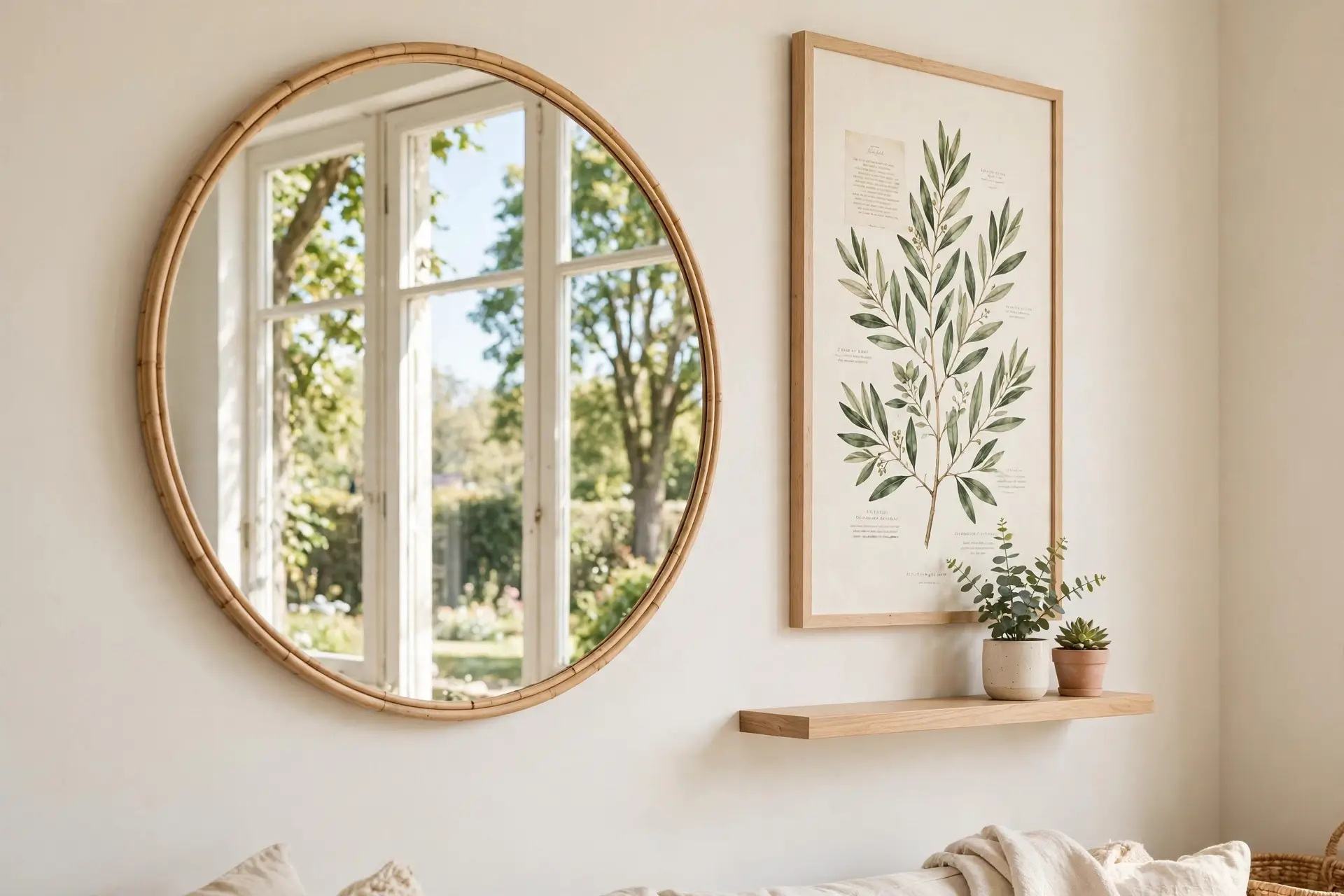 5 ILLUSIONS · 0 RENOVATIONS
Here's the secret nobody tells small-space dwellers: the walls are your biggest asset, not your biggest problem. Walls hold nearly three times the surface area of your floor — and in a small room, every square foot of wall you decorate cleverly is square footage you never had to buy.
But "cleverly" is doing a lot of heavy lifting there. Small spaces punish the usual instincts — a scatter of tiny frames, a dark moody accent, filling every inch. Below are the five illusions that actually work, each with three concrete moves and a "try this" starter. For bedroom-specific smallness, pair this with our small bedroom ideas guide, and see every technique in the wall ideas collection.
First: The 10-Minute Wall Audit
Before you buy a single frame, spend ten minutes reading your walls the way a designer would. Grab your phone and walk the room slowly:
1. Measure the real estate
Note each wall's width and where doors, windows, and switches interrupt it. The biggest uninterrupted stretch is your statement wall — everything else plays supporting roles.
2. Follow the light
Notice which walls get direct sun, which stay dim, and where shadows pool. Bright walls are your mirror and light-art candidates; dim walls need picture lights or warm sconces to join the party.
3. Walk the sightlines
Stand in the doorway — the wall you face is priority one. Sit where you sit most — the wall in your eyeline is priority two. Decorate in that order and you'll never waste effort on walls nobody looks at.
4. Photograph everything
Take phone photos of each bare wall. Photos flatten the room and reveal what your eyes miss — awkward proportions, dead corners, the wall that's begging for height or light. Plan from the photos, not from memory.
This audit takes ten minutes and saves you from the classic small-space error: buying decor first and finding walls for it later. Walls first, shopping second — always.
The Height Illusion
The eye follows vertical lines upward and assumes the ceiling is higher than it is.
The Depth Illusion
Layers and reflections convince the brain there's more room beyond the wall.
The Width Illusion
Horizontal movement stretches narrow rooms sideways — the hallway's best friend.
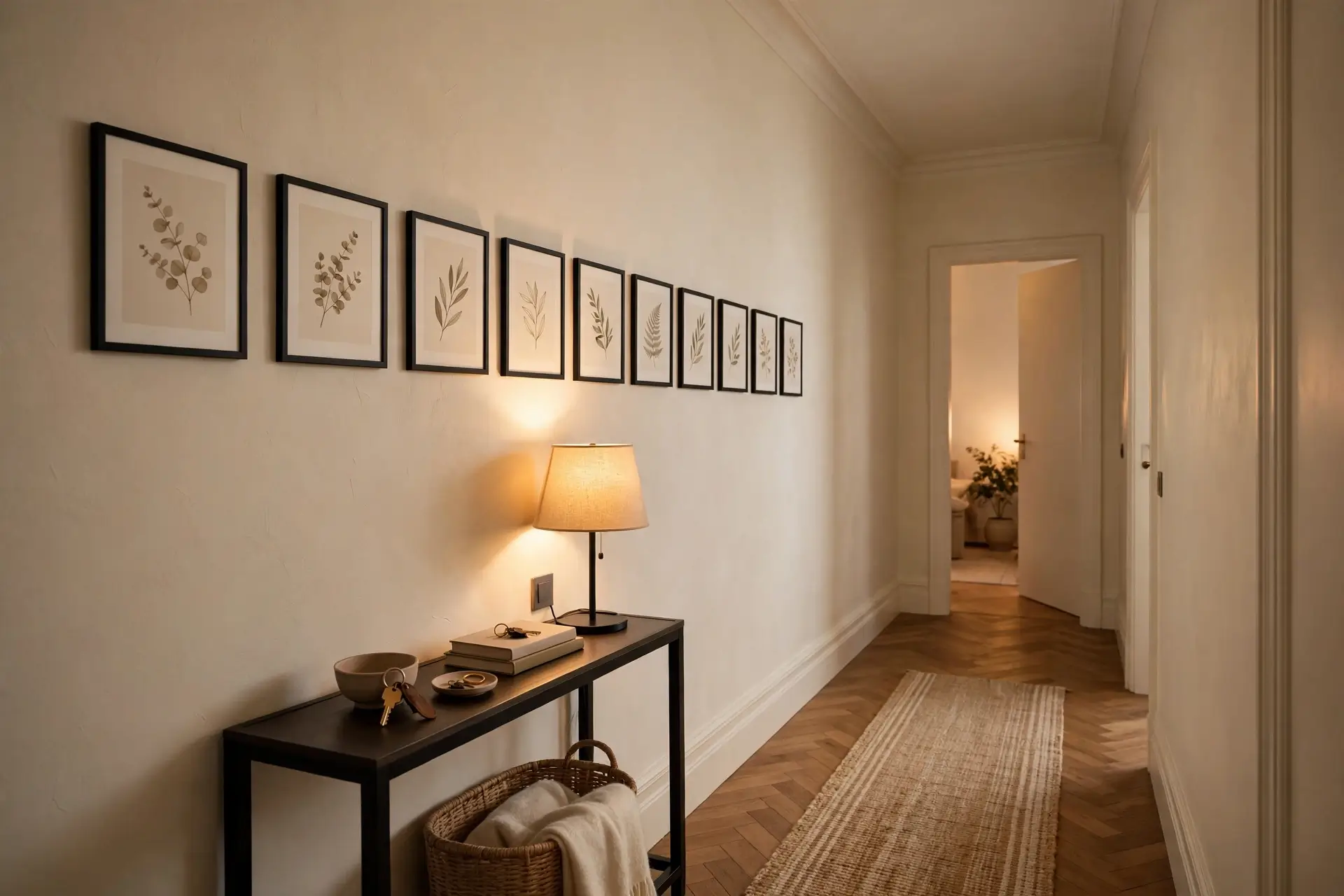
Illusion Nº 3 in action: one horizontal line of frames stretches a narrow hallway sideways.
The Light Illusion
Bright walls recede; dark walls advance. Light is the cheapest square footage there is.
The Air Illusion
Empty wall is not wasted wall — negative space is what makes small rooms breathe.
The Forgotten Walls: Small Spaces Room by Room
Small-space decorating usually obsesses over the living room and forgets the walls that see the most traffic:
Entryway walls
A mirror plus one hook rail: you check yourself, grab keys, and the narrow entry gains depth. The hardest-working four feet in the home.
Bathroom walls
Vertical stacked art, a tall mirror, and floating shelves above the toilet — decoration that doubles as storage. Our small-space thinking applies here too: every inch earns its keep.
Kitchen walls
Open shelving with beautiful dishes, a slim rail for utensils, one cheerful print. Kitchens are small rooms that forgot they're rooms — treat the walls like it.
Small bedroom walls
The headboard wall gets the statement; the opposite wall gets the mirror for morning light. See our bedroom ideas for layouts that pair with these wall tricks.
🏠 Renting? Every illusion here is renter-safe
- Adhesive strips and hooks hold light frames, mirrors, and shelves — check weight ratings and remove slowly with heat
- Peel-and-stick wallpaper and wall molding create stripes, panels, and accent walls with zero paint
- Lean oversized art and mirrors on the floor or console — no holes, huge impact
- Tension rods carry tapestries and textiles in hallways and over beds
- Your lease's "no nails" rule is not a design sentence — it's a creativity prompt
Five Small-Space Wall Mistakes
✕ A dozen tiny frames
Scattered small art chops the wall into visual confetti. Fix: one large piece, or group smalls into one tight composition that reads as a single unit.
✕ Dark, heavy statement walls
A black accent wall in a 10-foot room advances toward you. Fix: keep darks to textiles and small decor; let walls stay light so they recede.
✕ Decorating every wall
Four decorated walls in a small room feel like four walls closing in. Fix: the Air Illusion — leave the quietest wall nearly bare.
✕ Mirrors reflecting clutter
A mirror doubles whatever it sees — including the messy corner. Fix: angle mirrors toward windows, art, or greenery, never toward storage chaos.
✕ Ignoring the fifth wall
Ceilings in small rooms are free real estate. Fix: paint the ceiling a whisper of the wall color, or hang a pendant that draws the eye up — the Height Illusion's secret weapon.
Don't Decorate the Personality Out
A warning before you go full minimalist: small-space advice often slides into sterile. White walls, one mirror, nothing personal — technically spacious, emotionally empty. The illusions above are tools, not a personality transplant.
The rooms that feel biggest are the ones that feel loved: the travel print from the trip you'll never forget, the weird little sculpture, the photo that makes you laugh. Keep 2–3 pieces that are purely you, even if they break a rule. Give them the best wall (the entry sightline), frame them well, and let the illusions do the spacious work around them. A small room with soul always feels bigger than a big room without one.
The One-Wall Rule
Overwhelmed? Forget five illusions. Do this instead:
- Pick ONE wall — the one you see when you enter the room.
- Give it ONE illusion — a mirror, a tall print, or one wide shelf.
- Leave the rest alone for a week. Live with the breathing room.
- Then decide if wall two needs anything at all. Small rooms reward patience more than shopping.
Small Space Wall Decor FAQs
Should small rooms have big or small wall art?
Big — counterintuitively, one oversized piece makes a small room feel calm and intentional, while many tiny frames make it feel cluttered and smaller. Size the art to the wall, not the room: generous on the wall, and the room borrows the confidence.
Where should I put a mirror to make a small room look bigger?
Where it reflects light or something beautiful — ideally opposite or adjacent to a window, so it doubles daylight. Avoid aiming it at clutter, the TV, or a blank wall; a mirror doubles whatever it sees, so give it something worth doubling.
What colors make small space walls feel larger?
Light, low-contrast tones — warm whites, pale sage, soft greige — because bright walls visually recede. Keep art and frames in a similar tonal family so the wall reads as one continuous surface instead of chopped-up pieces.
How do I decorate walls in a rental without damage?
Adhesive strips and hooks for light frames and mirrors, peel-and-stick wallpaper or molding for accent walls, leaning oversized art on furniture, and tension rods for textiles. Every illusion in this guide has a no-holes version.
Can gallery walls work in small spaces?
Yes, with discipline: keep frames to two or three colors, spacing consistent and tight, and the whole arrangement reading as one unit. A sprawling, mismatched gallery shrinks a room; a tight, coordinated one becomes a single confident statement.
What's the biggest wall decor mistake in small apartments?
Filling every wall. Four decorated walls in a small room feel like the walls are closing in, while one strong focal wall plus breathing room feels curated and calm. When in doubt, the One-Wall Rule: decorate the entry-sightline wall first, then stop and live with it.
Keep exploring: every trick here lives in the wall ideas collection, and our living room ideas page shows these illusions in full-room context. Start from the Roomiora homepage if you're new here.
Working with a tiny bedroom specifically? The small bedroom ideas guide pairs layouts with these wall moves.
Malik Ashraf
Founder & Editor, Roomiora. Home-design enthusiast sharing real-life room ideas — tested layouts, honest costs, no showroom fantasies.
More about Malik →