Simple Kitchen Design Ideas That Make Cooking Feel Effortless
Forget the full renovation. Great kitchens are designed zone by zone — seven small areas, each with one job. Fix the zones and the whole kitchen falls into place.
 By Malik Ashraf · 13 min read
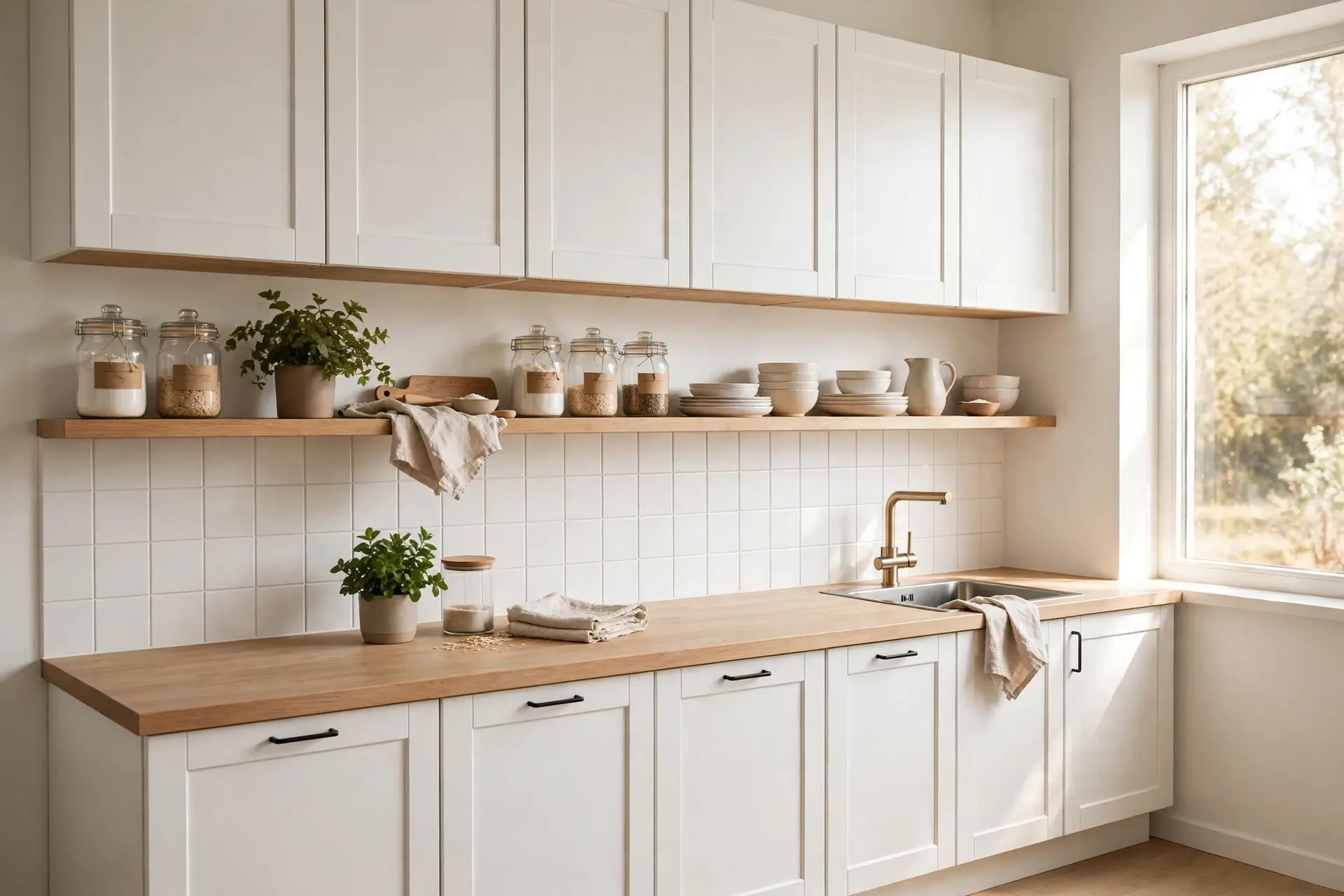 🍳 7 ZONES · 0 RENOVATION
The simplest kitchens aren't the emptiest ones — they're the ones where everything has a place and every place has a job. Professional kitchen designers think in zones: the cooking happens here, the prep happens there, the coffee lives in its own little world. When each zone works, the kitchen feels effortless even on a chaotic Tuesday night.
This guide walks you through the seven zones of a well-designed kitchen, with simple ideas for each — no renovation, no contractor, mostly things you can do this month. Use the zone map to jump around. For wall-specific inspiration, see our wall ideas and the full kitchen ideas collection.
Cooking Zone
The job: everything you touch while the heat is on — within one pivot, no cross-kitchen sprints.
- Keep tools at arm's reach. Spatulas, tongs, and wooden spoons in a crock beside the stove; oils and everyday spices on a small tray or wall rail right there. Every step you eliminate gets repeated hundreds of times a year.
- Give heat a landing pad. Trivets or a heat-proof mat next to the stove mean hot pans never travel across the kitchen. Simple, and it saves your counters.
- Light the cooktop properly. If your range hood light is dim or dead, a stick-on LED strip under the hood changes cooking completely — you can actually see what you're searing.
Prep Zone
The job: one clear stretch of counter where chopping, mixing, and assembling happen undisturbed.
- Protect one clear runway. Choose your best-lit counter section and defend it — no mail, no appliances that live there "temporarily." A clear prep zone is the single biggest upgrade a kitchen can get, and it costs nothing.
- Station the cutting board. A large board that lives on the counter (not in a cabinet) invites cooking. Pair it with a good knife on a magnetic strip or in a drawer insert nearby.
- Add a scrap bowl. A small bowl for peels and trimmings while you chop, emptied once at the end — tiny habit, dramatically cleaner prep.
Cleaning Zone
The job: dirty dishes in, clean dishes away — a loop so smooth you barely notice it.
- Put the dishwasher (or drying rack) next to the sink. The wet-to-dry path should be inches, not feet. If your layout fights you, a rolling cart as a bridge works surprisingly well.
- Store daily dishes near the dishwasher. Plates and glasses live in the cabinet closest to where they get clean — unloading becomes a two-minute job instead of a kitchen-wide walk.
- Corral the cleaning supplies. One caddy under the sink with everything — sponge, brush, dish soap — beats bottles scattered across three cabinets.
Storage Zone
The job: every ingredient and tool findable in seconds — the invisible engine of a simple kitchen.
- Decant the daily five. Flour, sugar, rice, pasta, coffee — into clear jars on one shelf. You see levels at a glance, and the shelf looks effortlessly styled.
- Go vertical inside cabinets. Shelf risers, stackable bins, and door-mounted racks multiply cabinet space without a single new cabinet. The back of a cabinet door is free real estate.
- Zone the pantry by frequency. Daily items at eye level, weekly above, rare-and-heavy below. If you reach past something daily to get something else, they've swapped places.
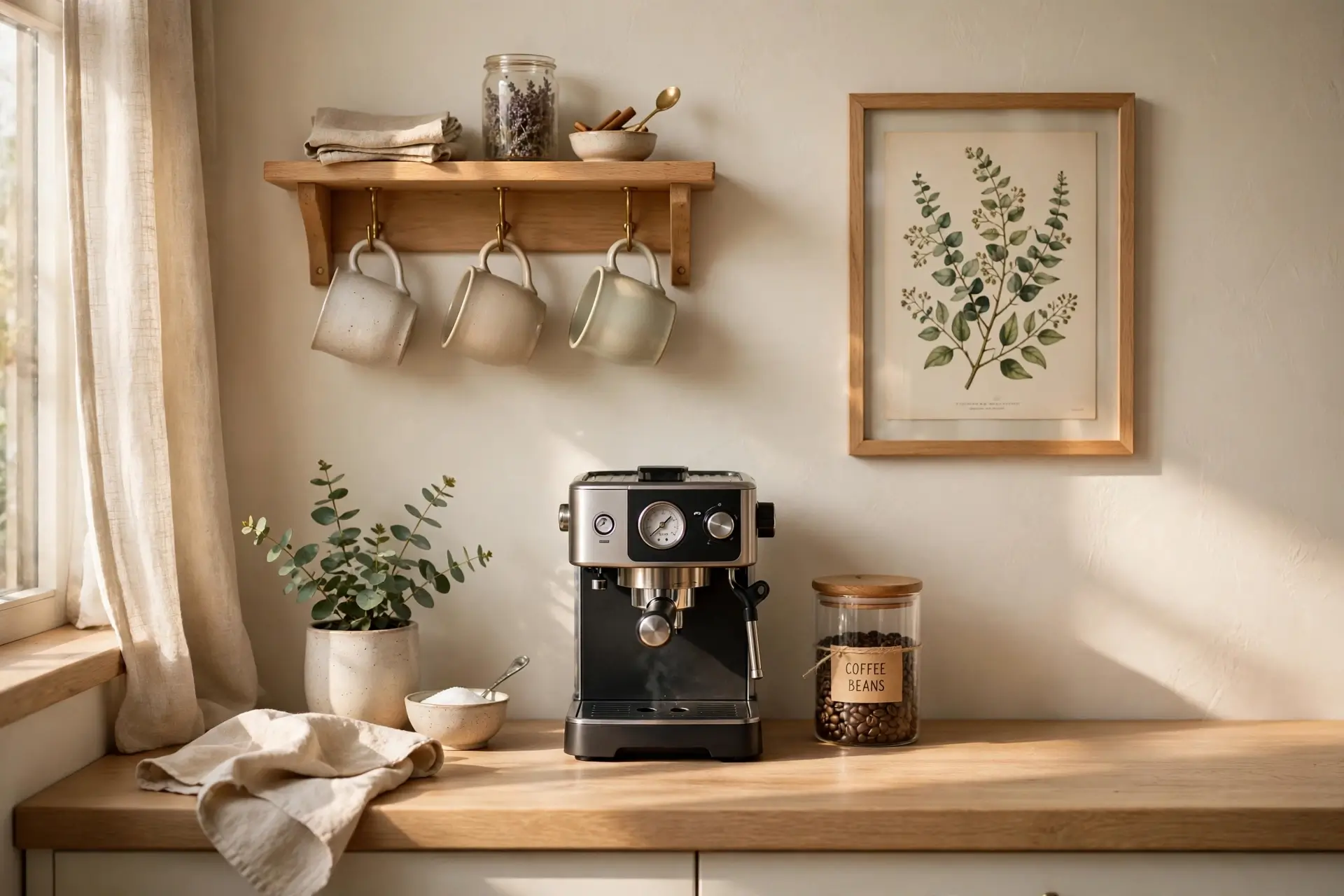
Zone 5 in action: a coffee corner needs only a shelf, hooks, and a machine — mornings sorted.
Coffee & Breakfast Corner
The job: the morning ritual, contained — so the rest of the kitchen stays calm before coffee.
- Contain the ritual to one spot. Machine, mugs on hooks, sugar, spoons — everything for the first cup within one square meter. Mornings run on autopilot when the station is complete.
- Hang the mugs. A small rail with hooks under a shelf turns mug storage into wall decor and frees a whole cabinet. Bonus: you actually use the pretty mugs when you see them.
- Add one warm detail. A small framed print, a tiny plant, a favorite quote — the coffee corner is the kitchen's emotional center; let it feel like it.
Dining Nook & Serving
The job: food gets from kitchen to table without a relay race — and the table invites lingering.
- Keep serving pieces near the table. A sideboard, a shelf, even a basket — platters and salad bowls live where they're served, not across the kitchen.
- Light the table separately. A pendant or even a plug-in sconce over the eating spot makes weeknight dinners feel intentional. Kitchens need task light; tables need mood light.
- Anchor with something soft. A washable rug under the table, a bench cushion, a small centerpiece that survives daily life — dining nooks earn lingering with comfort.
Walls & Vertical Space
The job: the walls work as hard as the counters — storage, light, and personality, all upward.
- Rail it. A wall-mounted rail with S-hooks for utensils, pans, or mugs frees drawers and looks like a professional kitchen. Stainless rail, wooden hooks — done.
- Shelf the pretty, hide the rest. One or two open shelves for beautiful daily items; everything else behind closed doors. Open shelving is display, not storage — curate it like a gallery.
- Mirror the light. A small mirror or glossy backsplash tile opposite the window bounces daylight deep into the kitchen. Dark galley kitchens benefit most.
🏠 Small kitchen? Zones matter even more
In a compact kitchen, zones overlap — the prep zone might be the dining table, the coffee corner might be six inches of counter. That's fine. The zones are about habits, not square footage: even in one galley wall, keeping cooking tools by the stove and cleaning supplies by the sink follows the same logic.
Small-space priority order: clear prep runway first, vertical storage second, everything else after. And keep the palette light and the upper cabinets minimal — visual air is free square footage.
🔑 Renting? Zones work without a single screw
Every zone in this guide has a no-drill version: tension rods inside cabinets for vertical storage, adhesive hooks for the mug rail and utensils, a rolling cart as an extra "zone" that moves where you need it, peel-and-stick backsplash for Zone 7's walls, and plug-in or battery lighting everywhere instead of hardwired fixtures. Landlords care about holes and paint — zone logic cares about neither. When you move, the zones move with you; they're habits and small freestanding pieces, not renovations.
Five Simple-Kitchen Mistakes
Storing things where they fit, not where they're used
The blender lives wherever there's space, so every smoothie is a treasure hunt. Fix: relocate by habit — daily tools near their zone, even if the "logical" cabinet is elsewhere.
Every counter is a storage counter
Appliances lined up like a showroom leave nowhere to actually cook. Fix: keep out only what you use daily; the rest earns cabinet space. Counters are workspace first.
One lonely ceiling light
A single overhead fixture leaves every counter in shadow — including the cook's own shadow over the prep zone. Fix: under-cabinet strips or even battery puck lights over the prep and cooking zones.
Buying organizers before decluttering
Beautiful bins full of things you never use are just organized clutter. Fix: remove first, then contain what's left. Most kitchens need fewer containers than expected.
Decorating before the zones work
Pretty shelves that block the prep flow, art where the rail should go. Fix: function first, beauty second — then beauty that serves function, like the styled open shelf.
The 5-Minute Nightly Reset
Zones only stay zoned if they get reset. Every night, five minutes, same loop:
- Counters clear — everything back to its zone; the prep runway empty.
- Sink empty — dishes in the dishwasher or on the rack, never "soaking overnight."
- Coffee corner staged — tomorrow's first cup ready to brew.
- One wipe — stove and the prep zone, thirty seconds each.
A kitchen that starts the day reset feels designed even when life isn't. The zones do the organizing; the reset keeps them honest.
The One-Weekend Kitchen Refresh
No renovation, no new cabinets — one weekend, zone by zone:
- Saturday morning: empty every counter completely. Clean them. Only return what you use daily.
- Saturday afternoon: relocate by zone — cooking tools to the stove, dishes near the dishwasher, cleaning caddy under the sink.
- Sunday morning: add the vertical layer — one rail, one shelf, or hooks where the zone needs them.
- Sunday afternoon: the coffee corner and one warm detail. Then cook dinner in your "new" kitchen.
Simple Kitchen Design FAQs
What is the simplest way to improve my kitchen without renovating?
Clear every counter and only return daily-use items, then organize by zone — cooking tools by the stove, dishes by the dishwasher. This zero-cost reset fixes most kitchen frustration before you spend anything.
How do I design a functional small kitchen?
Prioritize a clear prep area, then go vertical with rails, hooks, and shelf risers. Keep the palette light, limit upper cabinets visually, and store by frequency of use. In small kitchens, habits matter more than square footage.
What are kitchen zones and why do they matter?
Zones group everything by task — cooking, prep, cleaning, storage, coffee, dining. When tools live where they're used, you stop crossing the kitchen for every step. It's the professional kitchen's core idea, scaled to home cooking.
How can I add style to a rental kitchen I can't change?
Peel-and-stick backsplash, new cabinet hardware (keep the originals to reinstall), a rug runner, open shelf styling, and plug-in lighting. All reversible, all high-impact — and the zone logic works in any kitchen, rented or owned.
Open shelving or closed cabinets — which is better?
Both, in the right places: closed cabinets for the bulk of storage, one or two open shelves for beautiful daily items you actually use. Open shelves are display, not storage — curate them and keep them dusted.
What's the best lighting for a simple kitchen?
Layers: bright task lighting over prep and cooking zones (under-cabinet strips are the best value), plus one warmer light over the dining spot for atmosphere. If you do one thing, light the counters — it changes how the whole kitchen feels and functions.
Keep exploring: the full kitchen ideas collection is growing — plus wall ideas for kitchen walls and living room ideas for open-plan spaces. Start from the Roomiora homepage if you're new here. And remember: simple kitchens aren't finished once — they're maintained daily, one five-minute reset at a time.
Malik Ashraf
Founder & Editor, Roomiora. Home-design enthusiast sharing real-life room ideas — tested layouts, honest costs, no showroom fantasies.
More about Malik →