White Desk Setup Ideas: The Clean, Calm Way to Love Your Workspace
A white desk is a canvas — but a canvas needs contrast to become art. Four principles that keep white bright, calm, and never boring.
 By Malik Ashraf · 11 min read
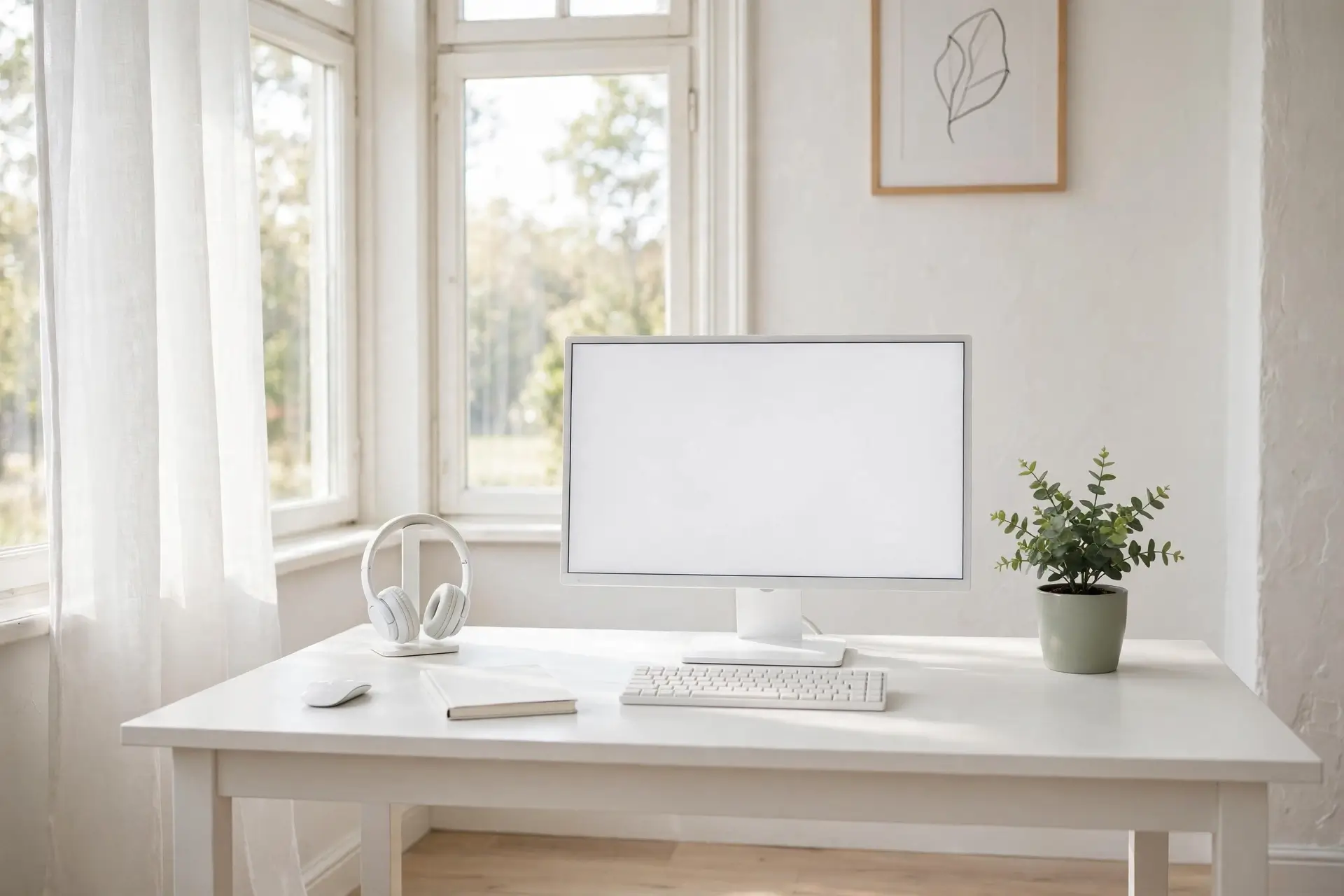 ⬜ 4 WHITE PRINCIPLES
Nobody dreams of a beige, cluttered, uninspiring desk. The white desk setup promises the opposite: a bright, calm, clear surface where your mind can actually think. And it delivers — white reflects light, visually expands small rooms, and makes everything you place on it look intentional. But white has a secret: on its own, it's flat. A desk that's all white with nothing to play against looks less "minimalist sanctuary" and more "unfinished." The magic isn't the white. It's what you put against the white.
That's the whole method in one sentence: white is the canvas, contrast is the art. The four principles below each add one kind of contrast — dark, texture, green, invisible — and each has a reference photo showing the principle in action. Work through them in order; each one builds on the last, and by the fourth your desk will look like the photos you saved. If your white desk sits against a blank wall, pair this with our wall ideas for a backdrop that earns its place.
The White Desk Paradox
Here's what nobody tells you: white shows everything. Dust, fingerprints, cable spaghetti, the coffee ring from Tuesday — all of it, in high definition. A dark desk forgives; a white desk testifies. That's not a reason to avoid white — it's the reason white desks force good habits. People with white desks consistently report tidier setups, not because they're tidier people, but because the desk demands it. The paradox: the highest-maintenance color produces the lowest-maintenance look. There's a second layer to the paradox, too: white is the easiest desk to style and the hardest to keep styled. Buying the pieces takes an afternoon; the daily five-minute reset is the real commitment. Embrace that trade and white will reward you daily, every single day.
The Light That Makes White Work
Before the four principles, one foundation: white desks live or die by daylight. Position yours near a window if you possibly can — natural light is what makes white glow instead of glare, and it's what lets your textures and plants do their work. In the evening, switch to warm white lighting (around 2700K); cool white light on a white desk can feel clinical, like an examination room. A warm desk lamp in the evening turns the same desk from "office" to "sanctuary." Light is the invisible fifth principle — get it right and everything below works twice as hard.
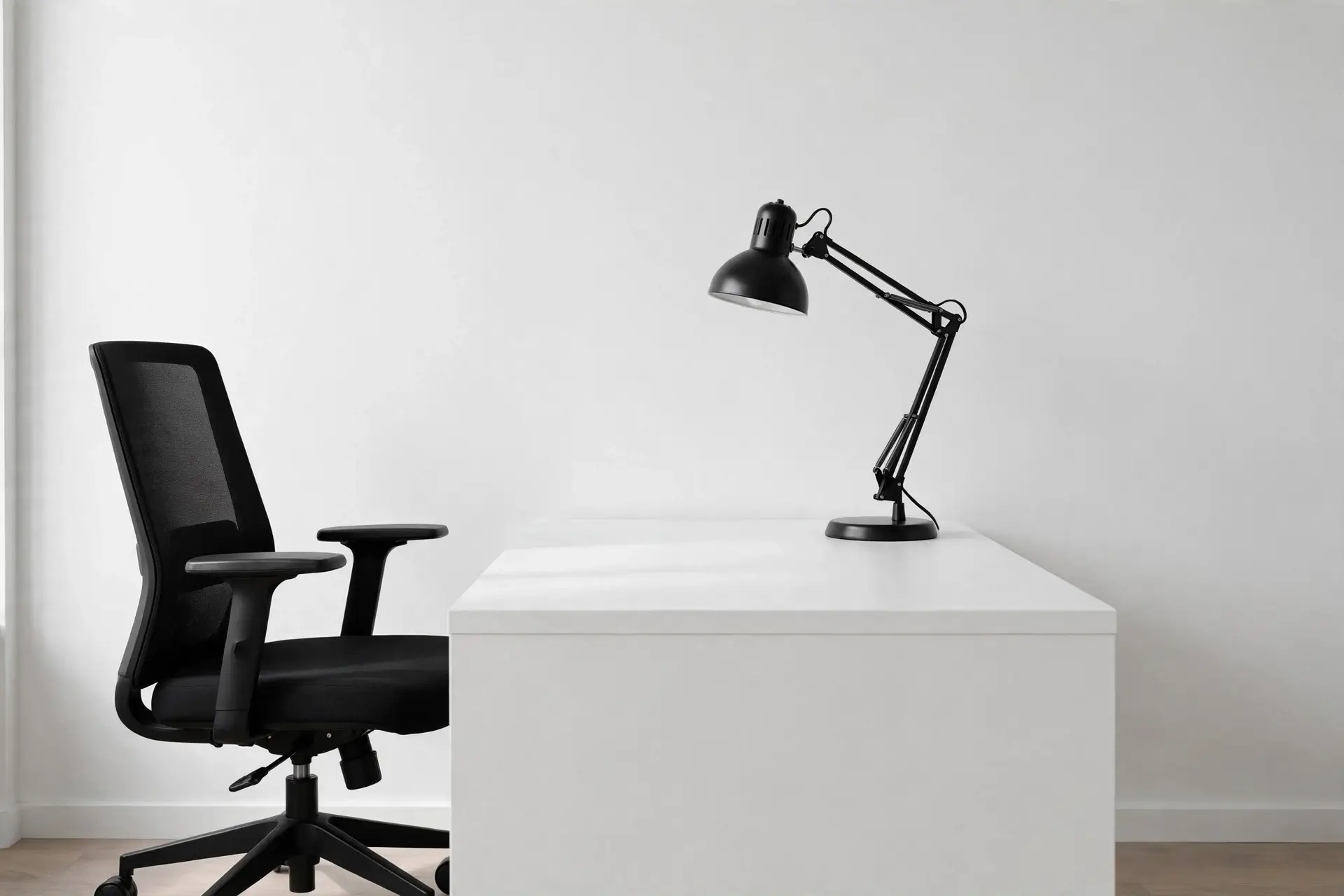
Give It One Dark Anchor
White without contrast is fog. One deliberate dark element — a black chair, a charcoal lamp, a walnut shelf — gives the eye somewhere to land and makes the white around it look brighter by comparison. This is the oldest trick in minimalism: the dark anchor is what makes people say "wow, so clean" instead of "wow, so... white." Keep it to one or two dark pieces; the moment dark competes with white instead of accenting it, the calm breaks. Think of it like punctuation in a sentence — a single full stop gives structure, but a page of exclamation marks is just noise. Your anchor is the full stop of the desk.
- Pick the anchor — chair is the classic choice (biggest object, biggest impact).
- Echo it once — a black lamp, black monitor frame, or dark planter. Twice is a theme; five times is a different desk.
- Stop there. Restraint is the whole game.

Layer Whites, Not Colors
The difference between a flat white desk and a rich one is texture. Linen desk mat, ceramic vase, wool throw, matte paper notebooks, a woven basket — all white or cream, all catching light differently. Your eye reads the variety of surfaces as depth even though the palette never changes. This is how high-end minimal interiors work: ten whites, zero boredom. Start with three textures and you'll feel the desk get warmer instantly, without adding a single color. The beauty of this principle is that it's the cheapest one — a linen mat and a ceramic mug cost less than any "statement piece," yet they do more for the look than most furniture upgrades.
- Soft under hands — linen or felt desk mat as the base layer.
- Hard on the desk — ceramic cup, stone coaster, wooden tray for contrast of material.
- Soft nearby — throw on the chair, cushion, or rug underfoot to complete the sandwich.
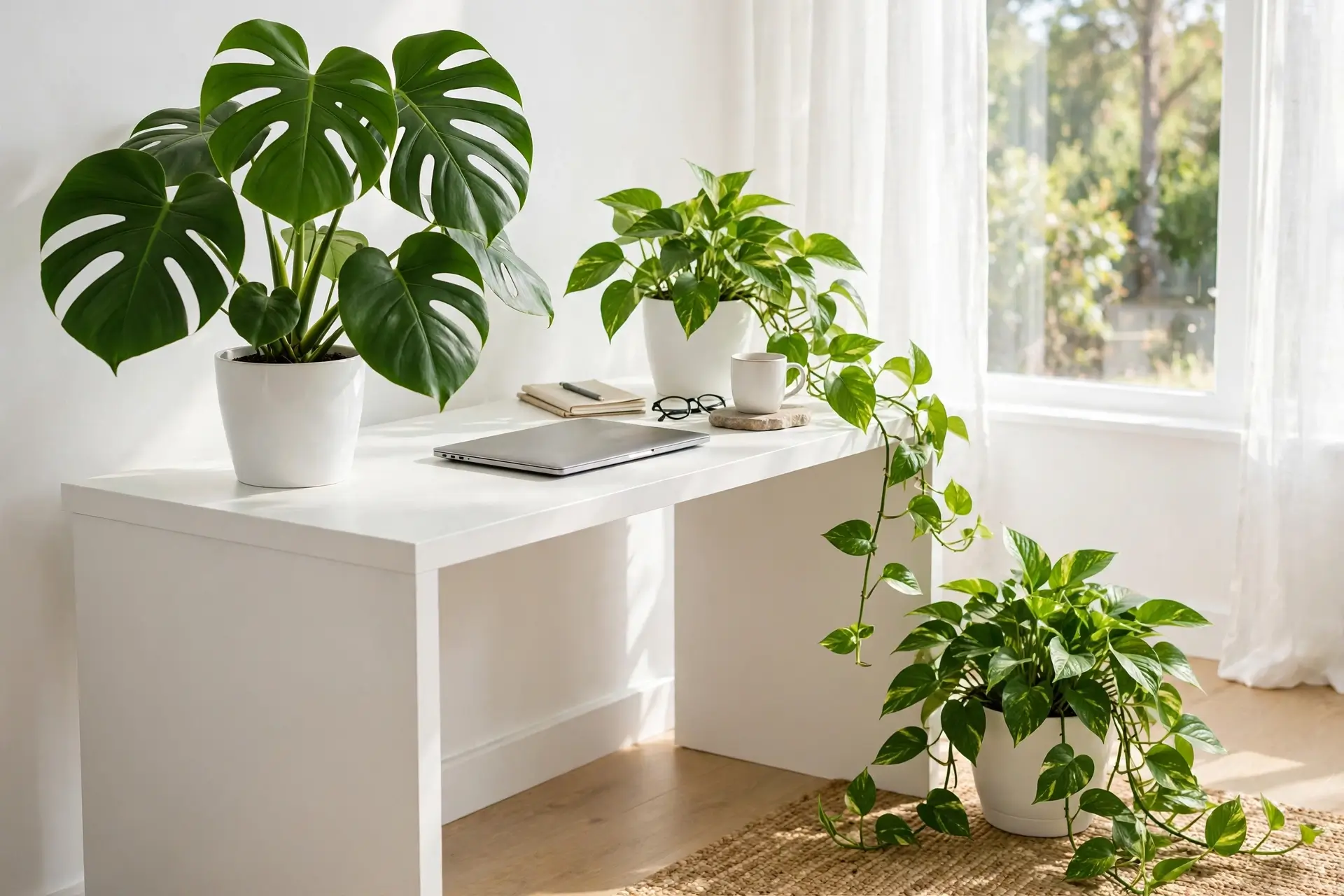
Let Green Do the Talking
Green is the best color for a white desk, and it's not close. Against white, every leaf looks more vivid — the white acts like a gallery wall for your plants. One medium plant (a pothos trailing off the desk edge is the classic) plus one small succulent is the whole formula. Beyond looking beautiful, plants solve white's biggest weakness: sterility. A white desk with no life can feel like a lab; the same desk with green feels like a studio. If you've killed every plant you've owned, a good faux monstera is an honest alternative — nobody audits your photosynthesis. And there's a practical bonus: caring for a plant gives your workday a tiny, pleasant break ritual — a splash of water, a turned leaf — that screens never provide.
- One trailer — pothos or philodendron spilling off a shelf or the desk edge.
- One upright — snake plant or small monstera in a white pot beside the desk.
- Keep pots white — let the green be the only color story.
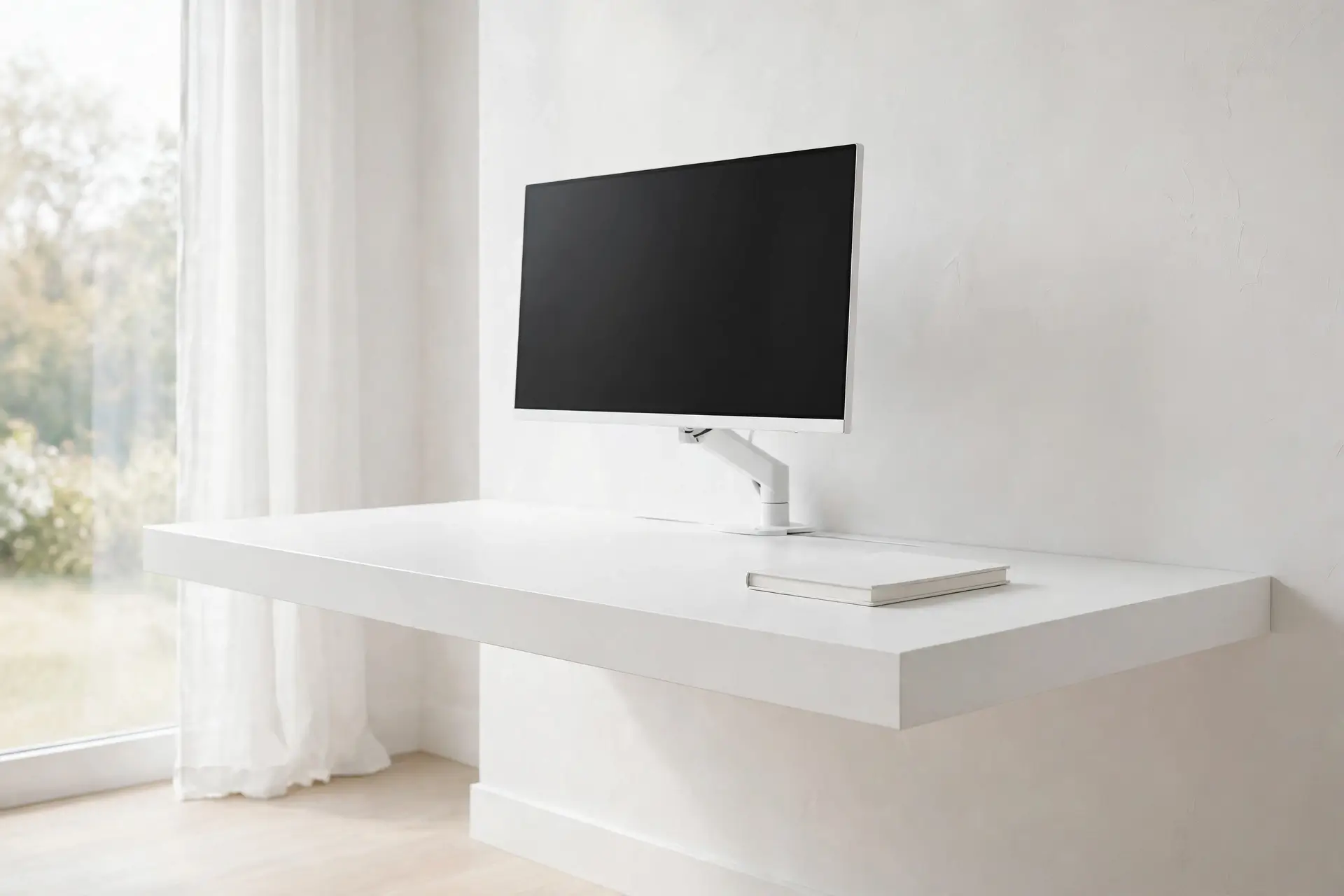
Hide Everything That Isn't Beautiful
This is the principle that separates white desks people admire from white desks people live with. Cables on a white desk are twice as visible as on a dark one — a black cable snake across white is the first thing anyone sees. The fix: a cable tray or raceway under the desk, a power strip mounted underneath (not on the floor behind), and wireless where it counts (keyboard, mouse). Same for clutter — closed storage, drawers, a single tray for the daily essentials. White rewards invisibility: the less you see, the more the white shines. Walk into any photo of a white desk you love and notice what's missing — no cables, no chargers, no paper stacks. That absence is designed, not accidental, and it's the highest-leverage hour you'll spend on the whole setup.
- Under-desk tray — every cable and the power strip live here, off the floor.
- One cable path — monitor and charger cables bundled in a single white sleeve to the tray.
- Daily tray — notebook, pen, glasses live on one tray; everything else in drawers.
🧽 The 5-Minute White Desk Maintenance
White stays white with a tiny weekly habit, not a deep clean. Do it Sunday evening and Monday starts with a desk that looks brand new:
- Microfiber wipe-down of the desk surface — 60 seconds, removes the dust film white loves to show.
- Cable check — one escapee cable rerouted to the tray before it becomes a nest.
- Tray reset — daily tray emptied back to its three essentials.
- Plant rotation — quarter-turn so it grows evenly and stays photogenic.
🤍 Who Should Skip the White Desk?
Honesty matters: if you eat most meals at your desk, have young kids with markers, or genuinely hate tidying, white will stress you out more than it soothes you. A light wood or mid-grey desk gives you 80% of the calm with a fraction of the maintenance. White is for people who find the ritual of keeping it clean satisfying, not for people who'll resent it.
White Desk for Renters
Renting? White is actually the renter's best friend — it bounces light around small rooms and makes landlord-beige walls look intentional instead of sad. You don't need to mount anything: a freestanding white desk, a tension-rod shelf above it, adhesive cable clips under the edge (check they're wall-safe and follow the manufacturer's instructions), and a large mirror leaning against the wall to double the daylight. Every principle in this article works without drilling a single hole. When you move, the whole setup packs into a car — try doing that with a built-in dark wood office. White is freedom in furniture form.
White Desk Mistakes
All white, no anchor
Everything white = visual fog, no focal point. Fix: one dark anchor (Principle 1) — non-negotiable.
Too many accent colors
Rainbow accessories on white look like a candy store. Fix: white + one dark + green. That's the whole palette.
Visible cable chaos
Black cables on white scream louder than anywhere else. Fix: under-desk tray + white sleeves (Principle 4).
Glossy white surfaces
Gloss shows every fingerprint and dust speck. Fix: matte or satin finishes everywhere you touch.
📸 The Screenshot Test
You'll know your white desk setup is done when you catch yourself screenshotting it — not to post, just to look at on a grey afternoon. It means:
- The white glows, not glares — texture layers catching daylight softly.
- One dark anchor holds the composition — the eye lands, then wanders calmly.
- Green pops — your plant looks like it was styled by someone with taste. (It was. You.)
White Desk Setup FAQs
How do I keep a white desk from looking boring?
Contrast is the answer: one dark anchor, layered white textures, and green plants. Boring white desks are flat because nothing plays against the white — add the three contrasts and boredom disappears.
Does a white desk show dirt easily?
Yes — white shows dust, fingerprints, and stains more than darker finishes. The trade-off is that it forces tidier habits. Matte finishes, a weekly microfiber wipe-down, and keeping food in the kitchen cut maintenance to minutes.
What color chair goes with a white desk?
Black or charcoal is the classic anchor — it grounds the whole setup. Light wood works for a softer Scandinavian feel. Avoid pure-white chairs unless you enjoy cleaning them; the chair takes the most wear.
How do I hide cables on a white desk?
Mount an under-desk cable tray holding the power strip and all cables, run monitor cables through a single white sleeve, and go wireless for keyboard and mouse. White cable accessories disappear against the desk; black ones stand out.
Can a white gaming setup look good?
Absolutely — white PC builds and peripherals look striking. Keep RGB subtle (white or soft single-color glow reads classier than rainbow), hide cables ruthlessly, and let one dark element (like the chair) anchor it.
Is a white desk good for a small room?
Yes — white reflects light and visually recedes, making small rooms feel bigger and brighter. Pair it with a light wall color and keep the floor visible under the desk to maximize the airy effect.
Keep exploring: browse the desk ideas collection, dress the wall behind your desk with wall ideas, or start fresh from the Roomiora homepage. Your white canvas is waiting — now go give it some beautiful contrast.
Malik Ashraf
Founder & Editor, Roomiora. Home-design enthusiast sharing real-life room ideas — tested layouts, honest costs, no showroom fantasies.
More about Malik →