Living Room Ideas With Green Accents: Fresh Without Going Full Jungle
Green is the hardest-working accent color there is — versatile, calming, timeless. Four threads below — living, textile, statement, quiet — each a complete way to weave it through your room.
 By Malik Ashraf · 12 min read
 🌿 4 GREEN THREADS
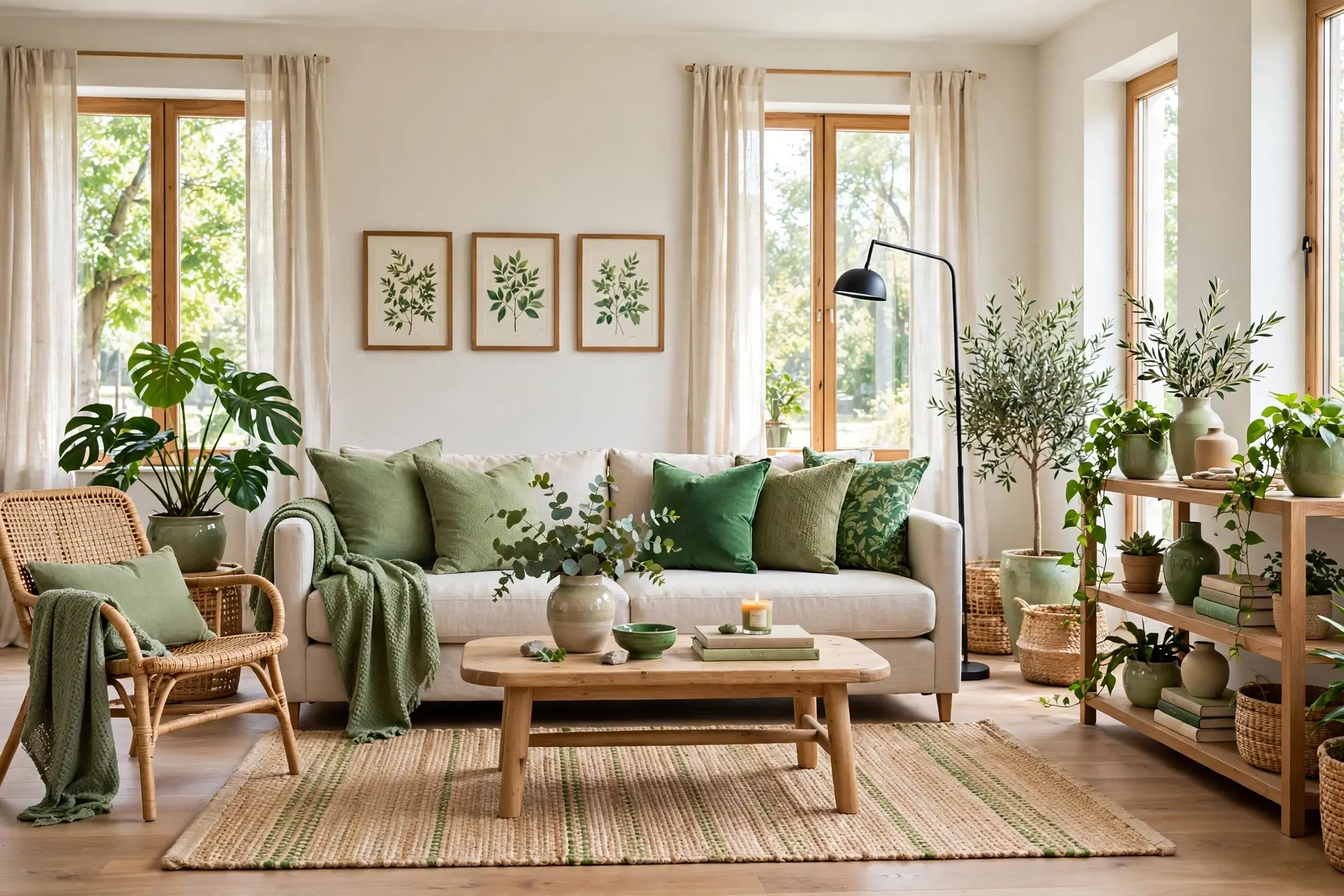
Of all the accent colors, green does something none of the others can: it makes a room feel alive. Blues calm, yellows cheer, reds energize — but green breathes. It's the color of growth, outdoors, and fresh starts, and our brains are wired to relax around it. The fear is going overboard: one day it's a tasteful cushion, the next it's a full jungle and you can't find the remote under the foliage. The answer is threading — weaving green through the room in deliberate, connected touches rather than dumping it in one corner. Four threads below, each with a reference photo and weaving instructions. Use one thread for a whisper of green, or weave all four together for a room that feels like a long, slow, deep breath. There's no wrong amount — only unthreaded amounts.
The key principle: green is a neutral that photosynthesizes. Like beige or grey, it goes with everything — wood, white, black, brass, terracotta, you name it. But unlike them, it adds life. Beige sits there; green grows there. That makes it the safest bold choice in decorating: all of the interest, none of the risk. For the full collection of room transformations, see our living room ideas — green is just the beginning.
Why Green Works in Living Rooms
Three reasons green beats every other accent. First, versatility: sage, emerald, olive, forest, eucalyptus, moss — there's a green for every palette, from minimalist to maximalist, from Scandinavian calm to bohemian lush. No other color covers this much stylistic ground. Second, biophilia: humans relax around nature cues, and green is nature's signature — a green room genuinely feels calmer. It's not mysticism; it's millions of years of associating green with water, food, and shelter. Your nervous system gets it even if your Pinterest board doesn't. Third, longevity: green doesn't date the way trendy colors do. Nobody ever walked into a room and thought "oh, that's so 2019" about sage cushions. Terracotta had its moment, millennial pink had its; green just keeps quietly working, year after year. It's the accent color you won't regret.
The Living Green
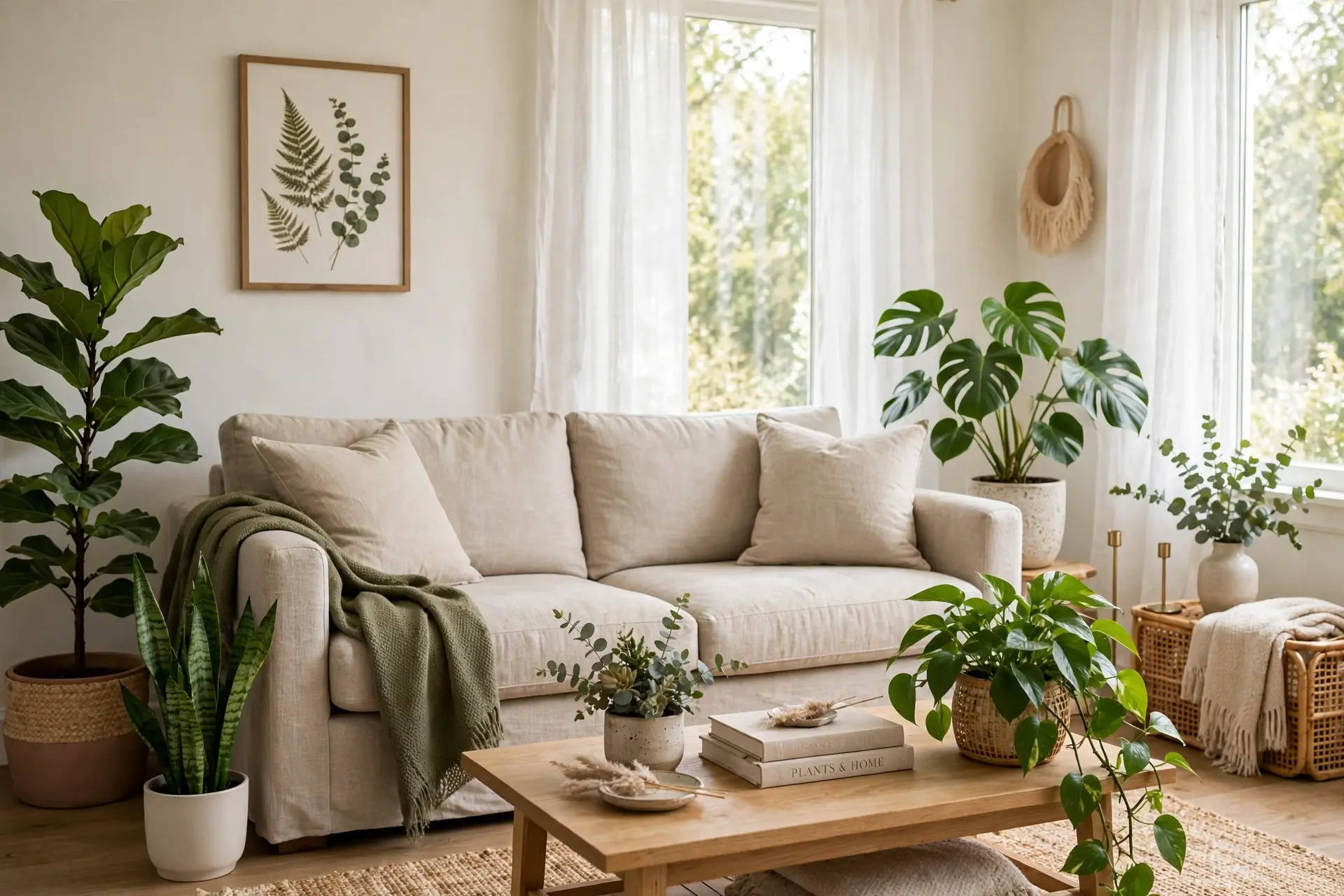
The original green accent: actual plants. No decor item does more per dollar — a $20 monstera transforms a corner, cleans the air (a little), and adds a living presence no object can fake. The threading technique, and the one most people get wrong: don't cluster all plants in one "plant corner." A plant corner is merely a collection; thoughtfully spread plants are a genuine scheme. Spread them — tall one by the window, trailing one on the shelf, small cluster on the coffee table — so green appears everywhere the eye travels. That's the thread: green as a path through the room, not a pile in the corner. When every sightline includes something living, the whole room feels tended and intentional — even if the laundry chair in the corner says otherwise.
🪴 How to weave it
- Three heights — tall floor plant, mid shelf plant, small tabletop cluster. Height variety reads as designed.
- Spread, don't stack — one plant per zone minimum. The thread must travel.
- Beautiful pots — ceramic, terracotta, woven. The pot is half the decor.
The Textile Green
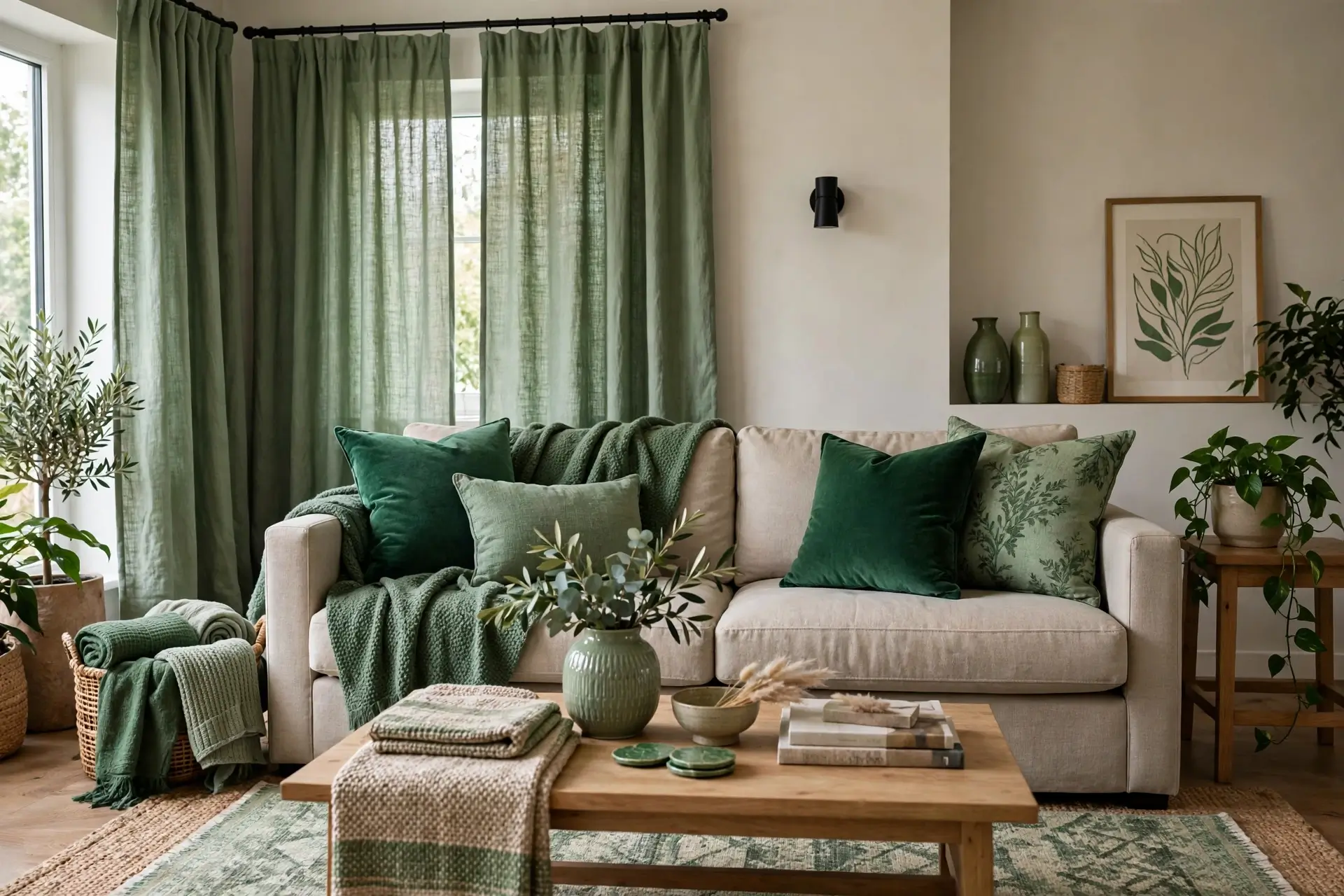
Cushions, throws, curtains, rugs — textiles are green's fastest delivery system. An emerald cushion here, a sage throw there, olive curtains framing the window: suddenly the room has a green story without a single plant. The threading rule that separates styled from random: repeat the green at least three times in different materials. Repetition is what turns a color into a decision. One green cushion is an accident; three green textiles in linen, velvet, and wool is a scheme. Vary the shades slightly — emerald, sage, olive together read as rich, not matchy. And mix the textures too: velvet catches light, linen breathes, wool grounds. Same color, three personalities.
🪴 How to weave it
- Rule of three — green appears in at least three textiles, three different materials.
- Shade range — mix deep emerald with soft sage. Monotone green is flat; range is lush.
- Anchor with neutrals — cream, beige, and wood let the green sing instead of shout.
The Statement Green
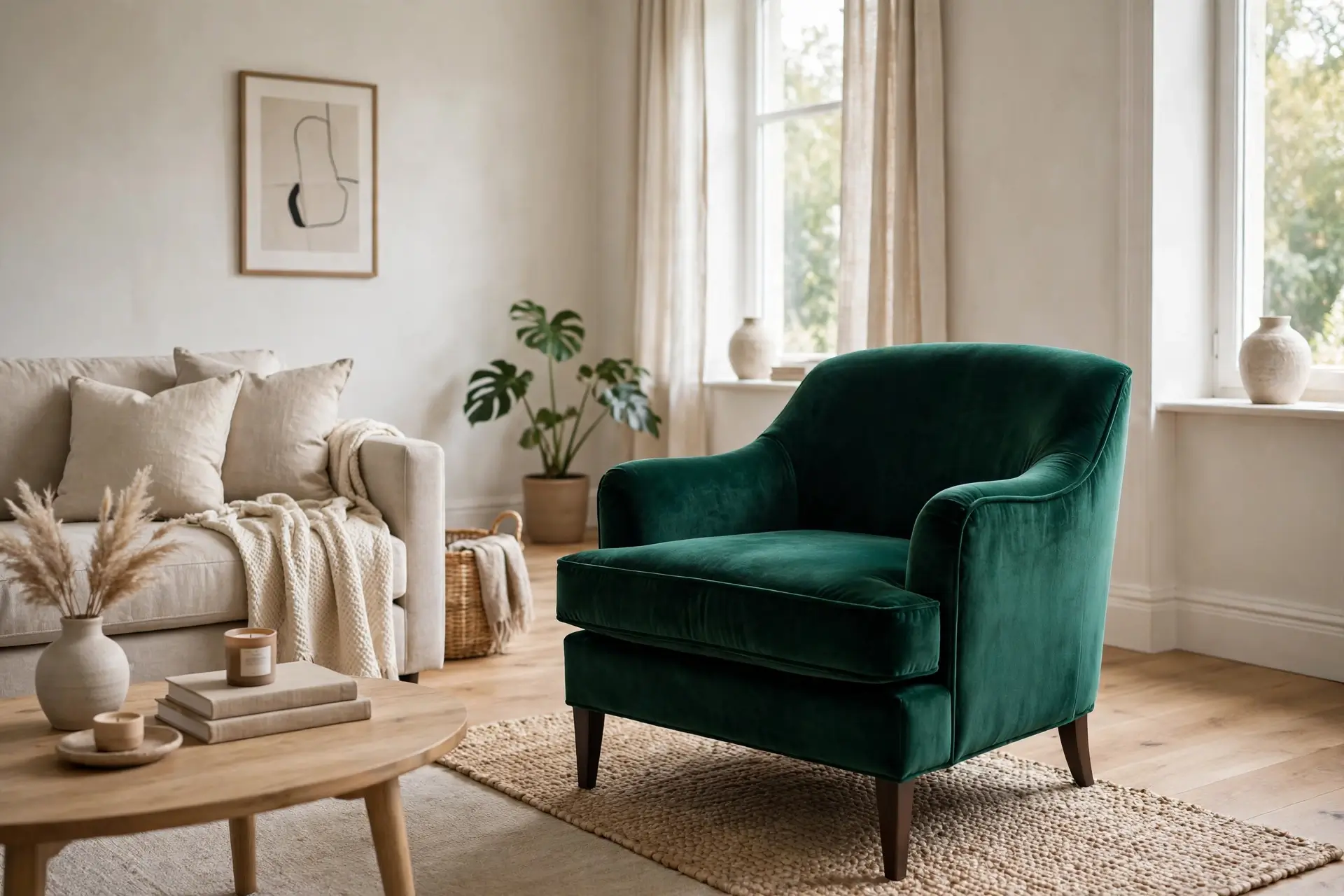
Sometimes one bold move beats ten small ones: an emerald velvet armchair, a forest-green accent wall, a deep-green bookcase. The statement piece becomes the room's exclamation point — everything else quiets down around it, and the whole space gets a focal point it was missing. The discipline that makes or breaks this thread: one statement, not three. Restraint is the whole luxury of the statement piece. An emerald chair plus a green wall plus green curtains is no longer a statement; it's a theme park. Let the hero have the stage. Walk into the room and your eye should land on the statement first, then wander — that's the choreography of a well-designed space.
🪴 How to weave it
- Pick the hero — armchair is the classic; accent wall and bookcase are strong alternatives.
- Quiet the surroundings — neutrals everywhere else. The statement needs silence to be heard.
- Echo once, softly — one small echo (a cushion, a plant) ties the hero to the room. Once, not five times.
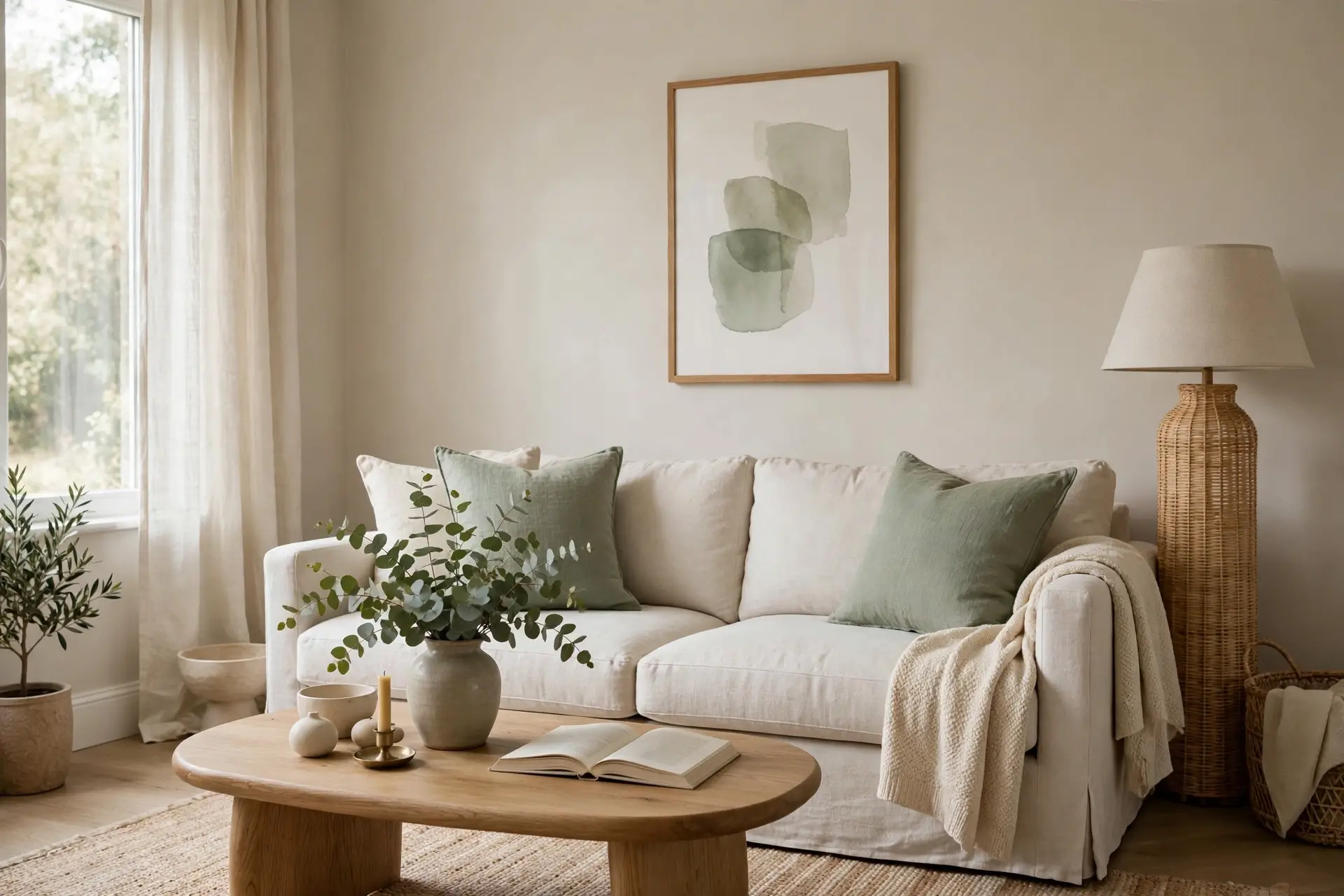
The Quiet Green
Not everyone wants emerald velvet — and that's fine. Quiet green is sage cushions, a eucalyptus sprig in a vase, muted botanical art, a soft green throw folded just so. It's green as a whisper: the room feels fresh and considered, but nobody would describe it as "a green room." Guests will say the room feels calm and put-together without being able to name why — and the answer is the quiet green working underneath everything. This is the thread for minimalists, for resale-conscious decorators, and for anyone who wants the calm of green without the commitment. Quiet green is also the easiest to live with long-term — it never shouts, so it never tires. And it's the thread that survives every future redecoration: sage works with whatever comes next.
🪴 How to weave it
- Sage and eucalyptus tones — muted, grey-leaning greens that sit back.
- Natural pairings — linen, light wood, stone. Quiet green loves quiet materials.
- Three whispers minimum — even quiet green needs repetition to read as intentional.
📏 The Green Ratio Rule
- Quiet (10%) — a few whispers: cushions, a sprig, art. Fresh without commitment.
- Balanced (20–30%) — the sweet spot: textiles + plants + one echo. Clearly green, completely livable.
- Bold (40%+) — statement piece territory: the emerald chair, the green wall, the full botanical moment. Stunning, but commit consciously — and keep the rest of the room neutral so the green has room to breathe.
- The test: squint at the room. Green should appear in at least three separate spots — that's a thread, not a dot. If you can only find it in one place, it's not an accent scheme; it's a stray cushion.
Green in Rentals
Renters, green is your superpower — almost every thread here is landlord-proof. Plants, textiles, and a statement armchair move with you; nothing touches the walls. The one exception is the accent wall, so renters should swap it for oversized botanical art or a peel-and-stick mural instead. You can take a fully "green" living room from rental to rental in a single car trip: cushions in a bag, plants on the back seat, art under your arm. Try doing that with a painted wall. Green is the renter's accent color for a reason — maximum impact, zero deposit risk.
🤝 Green Loves Company
Green's best partners: warm whites and creams (fresh and clean), natural wood (organic and warm), brass and gold (rich and a little glamorous), terracotta (earthy and Mediterranean), and brown leather (the classic forest-floor pairing — see our brown couch guide). Green's worst enemies: neon anything, cold grey overload, and competing brights. When in doubt, pair green with neutrals and let it be the only color talking.
Green Accent Mistakes
The plant pile
All plants crammed in one corner = jungle corner, dead room. Fix: spread green through every zone (Thread 1).
One lonely cushion
A single green cushion looks like a mistake, not a scheme. Fix: rule of three — repeat green in three materials minimum.
Three statements
Green chair + green wall + green curtains = chaos. Fix: one hero, quiet surroundings (Thread 3).
Fake-plant shame spiral
Cheap shiny faux plants read as plastic, not green. Fix: invest in one good faux or go real with unkillables — pothos, ZZ, snake plant.
🍃 The Fresh-Air Test
You'll know the green threading worked when:
- The room feels different with the windows open — inside green meets outside green, and the boundary blurs beautifully.
- Guests say "it feels so fresh in here" — the highest compliment a green thread can earn.
- You stop noticing it — the ultimate sign. The green has become part of the room's nature, not its decoration. That's when a mere accent graduates into full atmosphere.
Green Accent FAQs
How do I add green accents to my living room?
Start with the rule of three: repeat green in at least three places — say, plants, textiles, and one quiet echo like art or a vase. Spread them through the room rather than clustering. Begin with textiles (cheapest to change) if you're unsure.
What shade of green is best for a living room?
Sage and olive are the safest — calm, versatile, timeless. Emerald makes a stunning statement. Avoid neon or acid greens on large pieces; they date fast and fight everything.
Does green go with brown furniture?
Beautifully — it's the forest-floor palette. Green cushions, throws, and plants are the best companions for brown leather or wood. Warm greens (olive, sage) work best with warm browns.
How many plants should I have in my living room?
Three is the magic minimum: one tall, one trailing, one tabletop — spread across zones. More is fine if they're spread; the mistake is clustering everything in one corner.
Can I mix different shades of green?
Yes — mixing shades (emerald + sage + olive) reads as rich and layered, better than one flat green everywhere. Keep them in the same temperature family (all warm or all cool) for harmony.
Are green accents going out of style?
Green is the rare accent that doesn't really date — it's tied to nature, not trends. Sage, emerald, and botanical greens have worked for decades and will keep working. It's the safest "color" choice there is.
Keep exploring: the living room ideas collection keeps growing — including our brown couch styling guide — plus wall ideas for the walls behind your green. Start from the Roomiora homepage if you're totally new here.
Malik Ashraf
Founder & Editor, Roomiora. Home-design enthusiast sharing real-life room ideas — tested layouts, honest costs, no showroom fantasies.
More about Malik →