Luxury Kitchen Ideas That Feel Like a Five-Star Hotel
Luxury isn't a budget — it's a layer cake. Stone, jewelry, light, and one gallery moment. Four layers, stacked in the right order, turn any kitchen into the room guests photograph.
 By Malik Ashraf · 12 min read
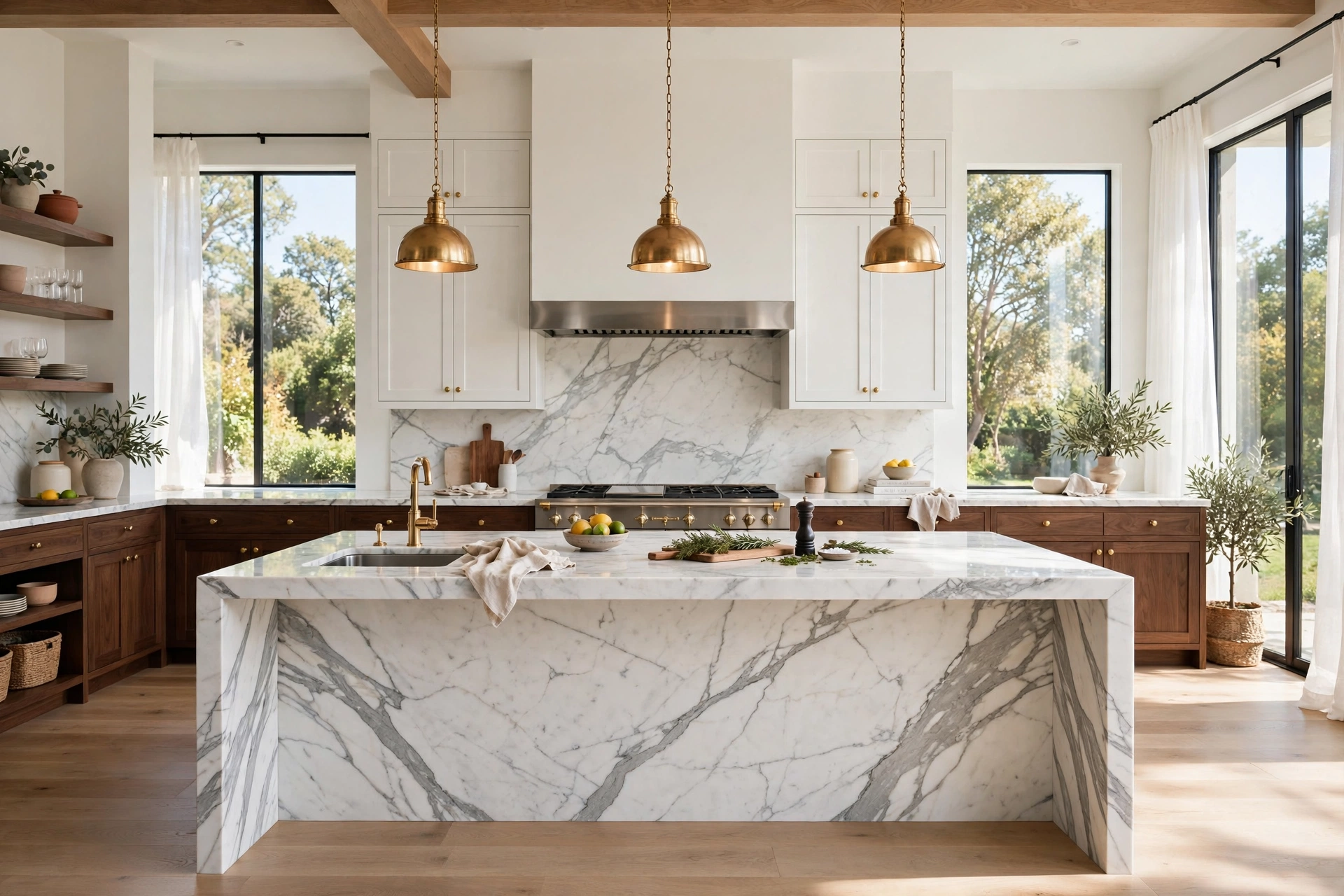 ✨ THE LUXURY LAYER CAKE
Here's what nobody tells you about luxury kitchens: the expensive ones and the clever ones are built the same way — in layers. A stone statement at the base. Metal jewelry on top of it. Sculptural light above that. And one gallery moment that makes the whole room feel curated. Miss a layer and the kitchen feels "nice but flat." Stack all four and guests start asking for your designer's number.
The beautiful part? Each layer has a full-budget version and a smart version. This guide gives you both — the look, the logic, and where to save without anyone noticing. For the practical foundations underneath the glamour, our kitchen ideas collection covers the everyday side.
What Luxury Actually Is: The Hotel Test
Think of the last five-star hotel bathroom or lobby that made you pause. What made it feel luxurious? It wasn't size — hotel bathrooms are often tiny. It was density of good decisions: every surface considered, every edge finished, nothing accidental. The tap had weight. The light was warm. There was one beautiful object placed exactly where your eye lands. That's the whole secret, and it transfers to kitchens perfectly.
Luxury is also, crucially, what's missing. No visual noise, no half-measures, no "we'll fix that later." A luxury kitchen feels inevitable — as if it couldn't have been any other way. You can't buy inevitability, but you can build it: one considered layer at a time. That's the layer cake. Four layers, each one simple on its own, each one making the next more powerful. Let's stack them.
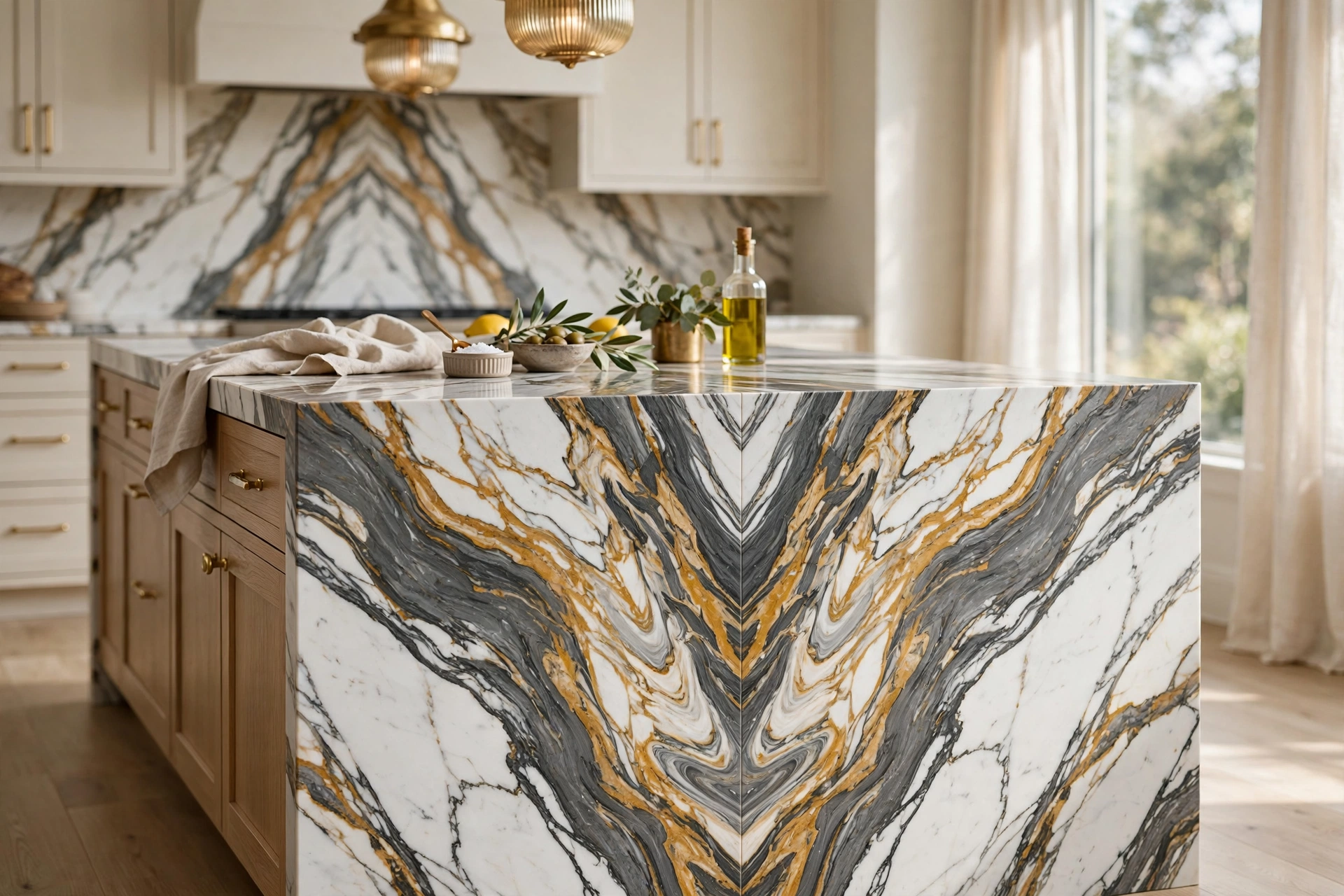 Layer 1 — The Stone Statement
Let One Stone Steal the Show
Every luxury kitchen has a protagonist, and it's almost always stone. A waterfall island in dramatic marble or quartzite — veining that moves like weather across the surface — does something no cabinet color can: it makes the room feel carved rather than assembled. One bold stone moment reads as wealth because it reads as confidence. You're not decorating around it; everything else is quiet so the stone can speak. And here's the practical truth designers won't always admit: stone is also the most photographed surface in the kitchen, which means it's the surface doing the most work for your home's perceived value — in listing photos, in dinner-party impressions, in your own daily pleasure.
Get the look
- Go bold on one surface — the island, or one full-height backsplash wall. Restraint everywhere else is what makes the drama work.
- Bookmatch if you can — mirrored veining on a waterfall edge is the single most "how much did this cost" detail in kitchen design.
- Keep surrounding finishes calm — quiet cabinets, simple hardware, so the stone stays the undisputed star.
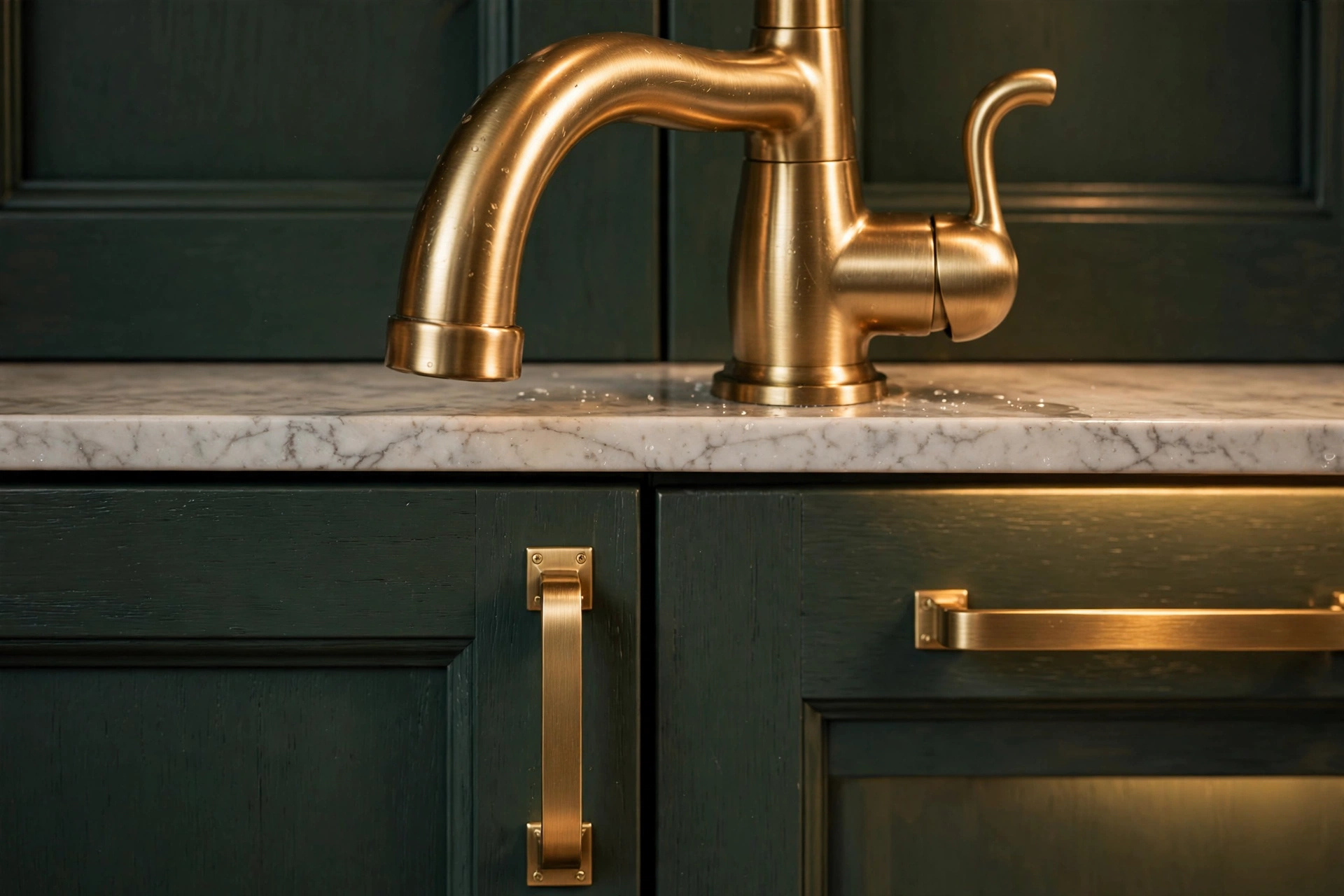 Layer 2 — The Jewelry
Dress It in Metal Jewelry
If stone is the outfit, metal is the jewelry — and jewelry is where luxury becomes felt. A brushed-brass faucet you touch fifty times a day. Solid, weighty cabinet pulls instead of hollow ones. A pot filler, a brass rail, hinges that close like a car door. Guests may not consciously register any of it, but their hands do. Luxury lives in the hundred tiny touches a kitchen accumulates, and metal is how you upgrade all of them at once. There's a reason jewelers display pieces under warm spotlights and on dark velvet: contrast makes precious things glow. Your kitchen works the same way — warm metal against deep cabinetry is the velvet-and-gold trick, applied to the hardest-working room in the house.
Get the look
- Pick ONE metal and commit — unlacquered brass, brushed bronze, or matte black. Mixed metals are a skill; one metal is a guarantee.
- Start where hands go — faucet, pulls, and knobs first. These are touched constantly, so quality here pays off daily.
- Let it age gracefully — unlacquered brass develops a patina that looks richer over time. That's a feature, not a flaw.
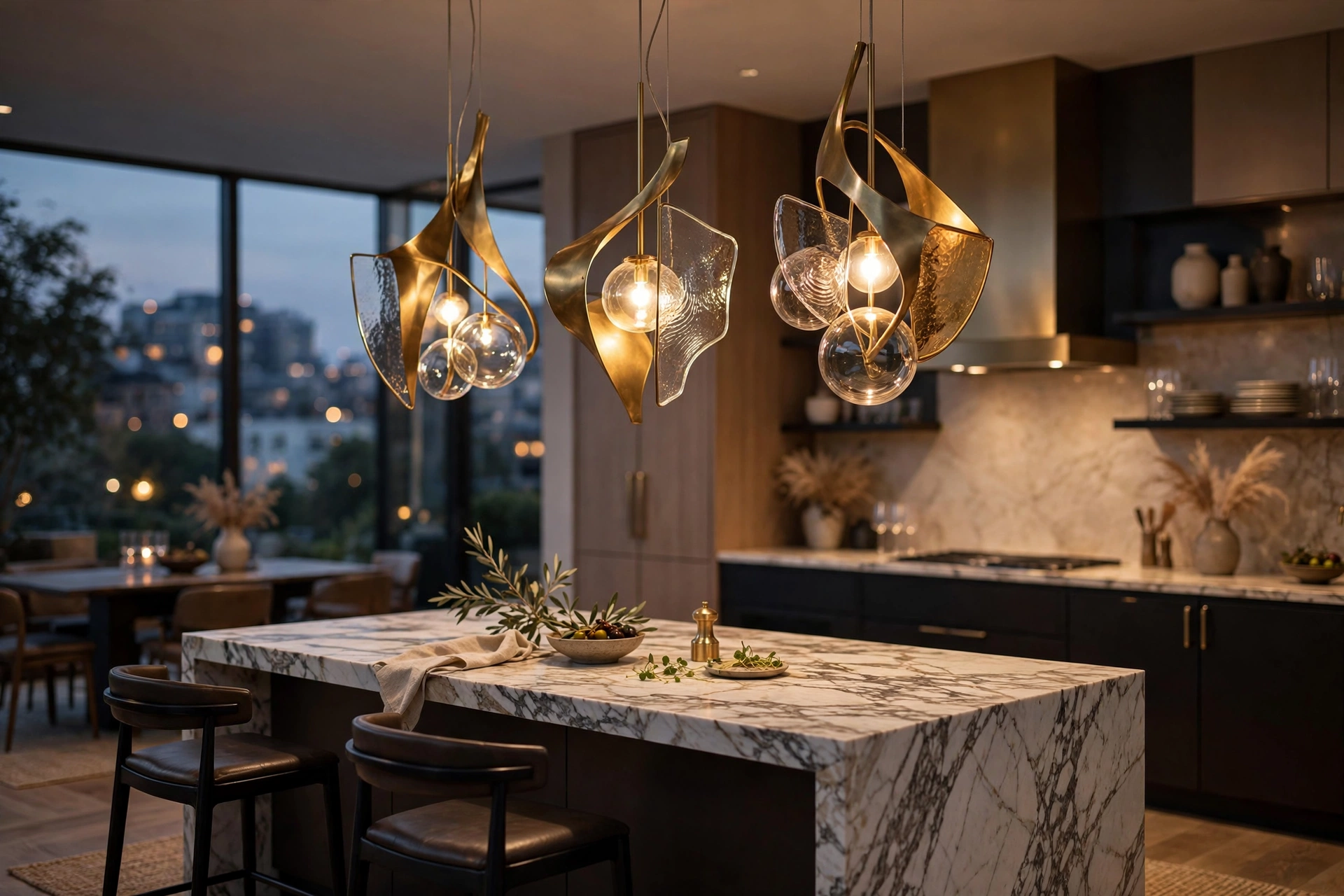 Layer 3 — The Light Sculpture
Hang Light Like Sculpture
In an ordinary kitchen, lights are appliances. In a luxury kitchen, they're art that happens to illuminate. A trio of sculptural pendants over the island — hand-blown glass, alabaster, hammered brass — draws the eye upward, gives the room a focal point at standing height, and photographs like a dream. This is the layer guests actually compliment, because it's the only one floating at eye level. Everything else in a kitchen sits low; pendants own the vertical space. They're also the layer that works hardest after dark: a kitchen with sculptural pendants on dimmers doesn't need a dining room to feel like an evening destination — the island becomes the destination.
Get the look
- Odd numbers, one design — three matching pendants over an island is the classic luxury rhythm. Two works for smaller islands; never four (it reads as a runway).
- Hang them low enough to matter — roughly 75–90cm above the counter is the widely used starting point, so they sit in the sightline, not lost near the ceiling.
- Dim everything — a dimmer on the pendants turns the kitchen from workspace to wine bar at 8pm. Luxury is a mood, and moods need dimmers.
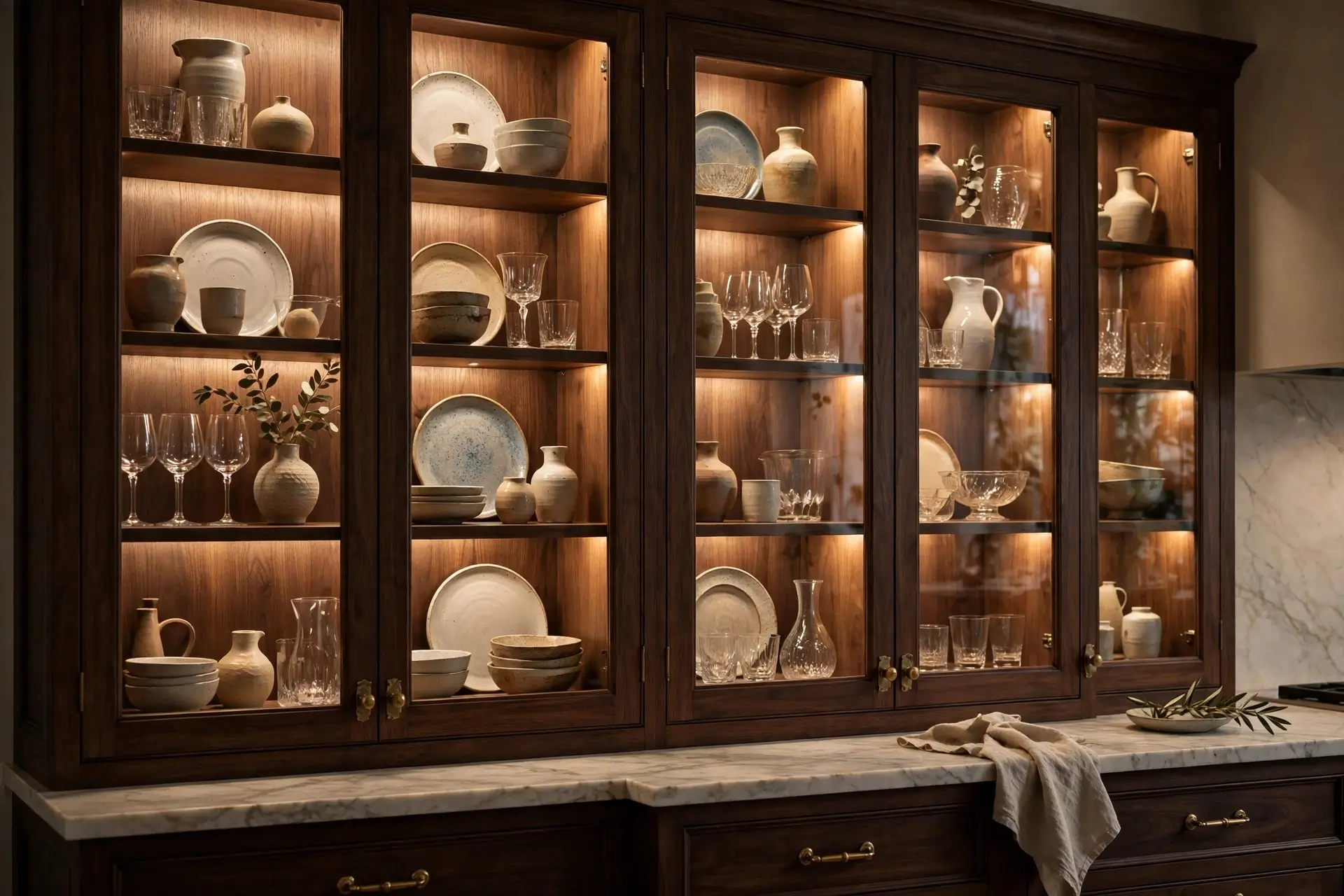 Layer 4 — The Gallery Moment
Add One Gallery Moment
The final layer is the one that separates "expensive kitchen" from "luxury kitchen": a moment of pure curation. Glass-front cabinets with interior lighting, styled like a gallery — ceramics, glassware, a small sculpture, nothing purely utilitarian. Or a single piece of real art hung in the kitchen. Or a styled bar corner that looks collected, not stocked. This layer says someone with taste lives here, and it's the layer money can't buy directly — it takes an eye, not a budget. It's also the most personal layer: the stone, metal, and light could belong to anyone with the budget, but the gallery moment is unmistakably yours. That's what guests remember — not the price of the marble, but the shelf that felt like you.
Get the look
- Light the display — interior cabinet lighting or a picture light turns ordinary shelves into a gallery. Light is what makes it feel intentional.
- Curate ruthlessly — five beautiful objects beat twenty pretty-good ones. Edit until removing one more thing would feel empty.
- Mix materials — ceramic, glass, wood, metal. A single material repeated looks like a set; mixed materials look like a collection.
📊 The 80/20 of Luxury
Roughly 80% of the "luxury" impression comes from 20% of the decisions. If the budget is finite — and it always is — spend it here, in this order:
- Lighting (Layer 3 + under-cabinet) — the fastest transformation per unit of spend. Nothing else changes how a kitchen feels this much.
- The faucet and hardware (Layer 2) — touched constantly, judged instantly.
- One stone moment (Layer 1) — the island or the backsplash wall, never both on a budget.
- The gallery styling (Layer 4) — nearly free, but only works once the first three layers exist.
What Cheapens a Kitchen Instantly
Too many finishes competing
Five-star hotels are calm. Six competing finishes is a showroom, not luxury. Fix: one stone, one metal, one wood tone. That's the whole palette.
Clutter on the stone
A dramatic island buried under mail, chargers, and small appliances wastes its entire job. Fix: the island is a stage — clear it nightly, style it with three objects max.
Cold, flat lighting
Harsh downlights make marble look like a hospital counter. Fix: warm dimmable layers — pendants, under-cabinet, display lighting. Luxury is never lit like an office.
Visible everyday chaos
Dish racks, detergent bottles, and sponge caddies on display undo every luxury layer. Fix: decant into beautiful dispensers, hide the rest. Luxury is partly just good concealment.
🌙 The Evening Test
Walk into your kitchen at 8pm with only the layered lighting on — pendants dimmed, under-cabinet glowing, display lit. A luxury kitchen passes when:
- It glows instead of glares — no single harsh source, just pools of warm light.
- One thing catches your eye first — the stone, the pendants, the gallery. Luxury always has a protagonist.
- You'd pour wine here, not just cook — the room invites lingering. That's the whole game.
Luxury Kitchen FAQs
Layered design: one dramatic stone surface, quality metal fixtures, sculptural warm lighting, and one curated display moment. Luxury reads as calm confidence — a few excellent decisions, not many expensive ones.
Spend where it's felt: warm layered lighting, a quality faucet and matching hardware, and ruthless decluttering with beautiful styling. A marble-look quartz and one statement pendant deliver most of the impression at a fraction of the cost.
Real marble is unmatched visually but etches with acids like lemon and wine. For a hard-working kitchen, marble-look quartz or porcelain gives you the drama with far less maintenance — many designers now prefer it for family kitchens.
Unlacquered brass and brushed bronze currently read as the most luxurious — they develop a rich patina over time. The key rule matters more than the choice: pick one metal and use it consistently across faucet, hardware, and lighting.
Absolutely — luxury is about material quality and editing, not square footage. One stone moment, one metal, sculptural lighting, and a single gallery shelf can make a compact kitchen feel like a jewel box.
Too many competing statement finishes — dramatic stone plus dramatic tile plus dramatic lighting cancel each other out. True luxury picks one drama per room and lets everything else whisper.
Keep exploring: the full kitchen ideas collection keeps growing, plus wall ideas for kitchen walls and living room ideas for open-plan spaces. Start from the Roomiora homepage if you're new here — and remember, luxury is a layer cake, not a price tag.
Malik Ashraf
Founder & Editor, Roomiora. Home-design enthusiast sharing real-life room ideas — tested layouts, honest costs, no showroom fantasies.
More about Malik →